
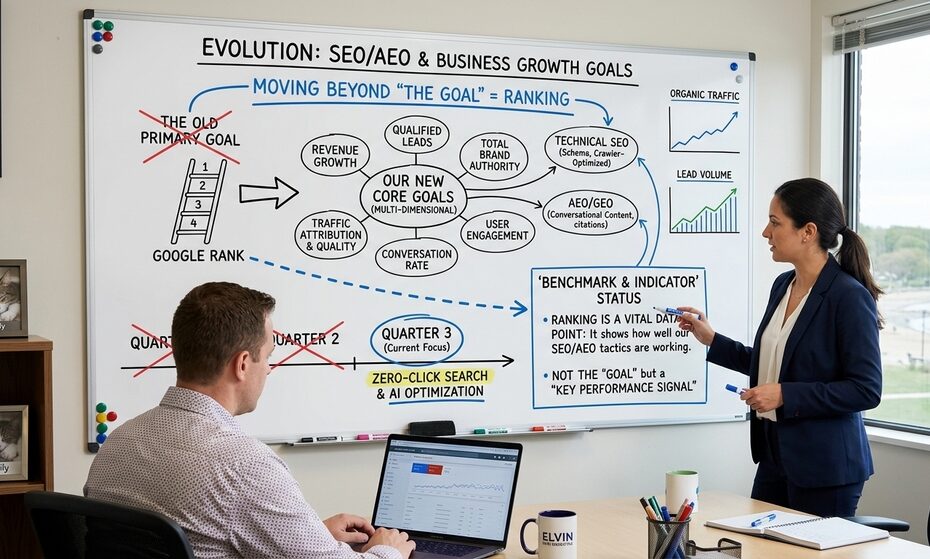
Google Rankings are Now a Benchmark , Not a Goal
If you’ve been watching your Google rankings jump around like a stock ticker this year, you’re not imagining it. It is, but you’re not doing anything wrong. Since Google’s May 2026 core update, search results have been more volatile than almost any stretch of algorithm history on record. A business that sat comfortably in the top three one week can vanish to page two the next, just to climb right back a few days later. This is happening even though you made no changes on your end at all.
Let’s break down what’s actually happening, why chasing a specific rank position is increasingly the wrong goal, and what we focus on instead when we manage SEO for our clients.
What’s Actually Happening: A Year of Record Volatility
2026 has been one of the most turbulent years for search rankings in memory, and the data backs up what business owners feel they are seeing.
-
The March 2026 core update
The March update caused nearly 80% of top-three results to change position. More striking, about 24% of pages that had been sitting in the top 10 fell out of the top 100 entirely, up sharply from the already disruptive December 2025.
-
The May 2026 core update had a profound effect on Google ranks
This one most businesses are still feeling the aftershocks of. The May update rolled out over nearly 12 days (May 21 to June 2) and was described by SEO analysts as even heavier than March. Position changes hit roughly 76–80% of top-three rankings and nearly 90% of top-10 rankings, with volatility spiking not once but repeatedly: on the first weekend, again around May 30, and even in the final 24 hours before Google marked it complete. industry veteran Glenn Gabe summed it up bluntly: “March was meh, but May is big.”
-
The volatility didn’t stop there.
An unconfirmed volatility event hit in early May before the official update even launched. More unusual movements showed up in August with no official update acknowledged by Google. The August 2026 spam update pushed 16.7% of previously top-10 pages beyond position 100. That is nearly double the rate from a comparable period in July
Google has been recalibrating how it evaluates content quality, expertise, and AI-generated content almost continuously this year, with the sharpest analysis falling on YMYL (Your Money, Your Life) sites. On health, finance and legal websites. thin or aggregated content, and pages that read like unedited AI output have felt the biggest impact. During any active rollout, this movement is expected and temporary. Google itself advises waiting a full week after a rollout completes before drawing conclusions from your dat). But even accounting for that, 2026’s pattern of update-after-update has made “where do I rank today” a far less stable question than it used to be.
Why Google Rankings Still Matter — The Case for It
None of this means page rank is meaningless. It still plays a real role:
-
They’re a strong leading indicator of clicks.
Position 1 has historically captured close to 40% of clicks on a given search, with a steep drop-off after that. The gap between position 3 and position 8 isn’t incremental, it’s an order of magnitude.
-
They’re diagnostic.
If your traffic drops before your rankings do, that points to a click-through or snippet problem. If rankings drop first, that points to a relevance or quality signal Google is questioning. Rank is a useful early-warning system even when it isn’t the end goal.
-
They still correlate with AI citations.
Being ranked number 1 remains one of the strongest predictors of being cited inside an AI Overview or chatbot answer, even if it’s no longer a guarantee.
-
Google rankings are useful competitively.
Giving you a rough read on how you stack up against the businesses fighting you for the same customer.
So, don’t ignore rankings, but stop treating them as the finish line.
Why Rank Alone Doesn’t Matter Anymore. The Case Against It
Here’s where most business owners get stuck, and where a lot of agencies still oversell rank tracking as the whole story.
-
The rank you see isn’t the rank your customer sees.
Rank position is personalized, localized, and device dependent. Two people searching the same phrase from two different phones can see two different result orders. When you check your position and see you rank second, that’s your snapshot. It’s not necessarily what your actual customers encounter.
-
“Position 1” doesn’t mean what it used to.
Before a searcher ever reaches your organic listing, they may scroll past paid ads, an AI Overview, a local map pack, shopping results, videos, and a “People Also Ask” box. You can technically hold the #1 organic spot and still be effectively “below the fold” on the page.
-
Rank without intent is a vanity number.
Ranking #1 for a broad, generic phrase that attracts window-shoppers is often worth less than ranking for a specific, high-intent phrase from someone ready to buy. Position without the right intent behind it tells you nothing about whether that traffic is worth having.
-
Rank doesn’t tell you what happens after the click.
A page can hold a beautiful top three position and still have a 90% bounce rate and zero conversions. That’s not SEO success; that’s a business generating zero value from a lot of visibility.
-
In a volatile-update year, rank is simply unstable data.
When 80% of top three positions are shifting during a rollout, a single day’s rank check tells you almost nothing reliable. Building a client relationship or a business strategy around a number that swings that hard, that often, sets everyone up for unnecessary panic.
Think of rank is a leading indicator, not an outcome. Treating it as the outcome is where the “rankings don’t matter” mindset comes from. In a year like 2026, that mindset is more justified than ever.
What We Focus on Instead
At Elvin Web Marketing, we’ve shifted client reporting away from “where do we rank today” and toward a framework built around four things that actually reflect business impact: Visibility, Trust, Action, and Revenue.
Visibility beyond the traditional SERP
We track visibility across the whole modern search environment, not just the ten blue links:
- Google Business Profile and local map pack presence
- Search Console impressions and click trends by query cluster (not single keywords)
- Whether the business shows up when we test real customer questions. We check inside Google AI Overviews, ChatGPT, Gemini, Perplexity, and Copilot. These are what we call Absolute Mention Rate. We measure how our client compares to competitors being mentioned for the same prompts.
This matters because AI-generated answers are increasingly replacing the click entirely. Being “visible” today means being the business an AI assistant recommends, not just the tenth blue link on a results page).
Trust – is the right audience finding you
CTR by query, non-branded vs. branded traffic share, engagement, and growth in branded search over time. Rising branded search, in particular, is one of the clearest signs that visibility is turning into genuine market recognition, not just algorithmic luck.
Action is anyone actually doing something
Form fills, calls, booking requests, and other on-site conversion events, tracked by landing page and traffic source. A page ranking #1 that converts at 0% is not a win. A page ranking #5 that reliably turns visitors into booked jobs is.
Revenue, are the efforts paying off
Organic sourced leads and revenue plus a rough cost-per-acquisition comparison against other channels. This is the number that actually justifies the SEO investment to a business owner. A keyword-rank screenshot has little or no value.
What This Means for Your Business
If your rankings have been jumping around since May, that’s the algorithm recalibrating, not a sign your SEO is broken. It’s not something to panic about. You shouldn’t rewrite your whole site the week it happens. What we’d rather see, month after month, is whether the right people are finding you, whether they trust what they find enough to engage, and whether that engagement turns into calls, leads, and paying customers.
Rank position still earns a line in every report we send. It’s a useful compass. But it stopped being the destination, and in a year defined by this significant algorithmic turbulence, businesses that keep chasing a specific rank number are chasing a moving target. Businesses that focus on visibility, trust, action, and revenue are building something the algorithm can’t shake loose.