
How Gemini 3.5 Flash Changes SEO Forever
If you run a business and care about being found online, the announcements from Google I/O 2026 last week is an important thing you’ll read. Google released Gemini 3.5 Flash. It’s not just another AI model. It fundamentally rewired how search works for over a billion people.
Here’s what happened, what it means, and what you need to do about it.
What Google Just Announced About Gemini 3.5 Flash
At its annual Google I/O developer conference on May 19, 2026, Google unveiled Gemini 3.5 Flash, its most powerful AI model yet. Immediately, they deployed it as the default engine powering AI Mode in Google Search globally. The same day, Google announced the biggest redesign of the Search box in over 25 years. A new suite of AI agents will run 24/7 in the background monitoring the web for users, and full generative UI capabilities coming to Search this summer.
As Google’s VP of Search, Liz Reid, stated plainly at the keynote: “Google search is AI search.”
This wasn’t a beta test. This wasn’t a feature rollout for a small group. This was a global, immediate deployment to everyone using Google Search.
For local businesses, marketers, and SEO professionals, this changes everything. The implications are enormous:
- Fewer traditional clicks
- More AI-generated answers
- Increased importance of authority and trust signals
- Greater emphasis on brand presence across the web
- A complete redefinition of what “ranking” means
The reality now has become that SEO is no longer only about ranking pages. It is now about becoming a trusted source inside AI-generated ecosystems.
The Anatomy of Gemini 3.5 Flash in Search
To understand the impact on SEO, we must first understand why Google chose Gemini 3.5 Flash. Historically, deploying massive Large Language Models (LLMs) to handle billions of searches a day was bottlenecked by two critical constraints: latency (speed) and compute costs.
Why Google Built Gemini 3.5 Flash
In the past, using smart AI to answer billions of searches every day was too slow and too expensive. Google built Gemini 3.5 Flash to fix that.
Think of it as a super-powered brain upgrade for Google Search that does three things:
-
Instant Speed: It reads and answers questions in less than a second—faster than you can blink. This allows Google to build custom AI answers right on the screen while the user is waiting.
-
Massive Memory: It can read and memorize dozens of long, complex websites all at the exact same time. It doesn’t just skim your site; it digests your entire history in a flash.
-
Sees, Hears, and Reads: The AI doesn’t just read your website’s text. It actually “looks” at your photos and “watches” your videos all at once to see if you have the best answer.
Google isn’t just looking for matching words on a page anymore. Because this new system is so fast and smart, it can instantly tell the difference between a generic, copy-and-paste website and a real local expert.
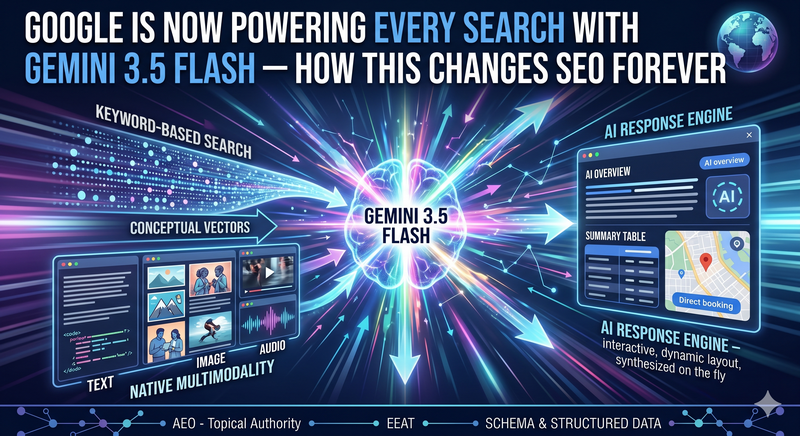
Instead of merely retrieving documents, Google Search now uses Gemini 3.5 Flash to comprehend the user’s intent deeply, extract answers from across the web, and synthesize them into cohesive, native AI Overviews (formerly SGE) and real-time interactive search modules.
More key facts:
- 4x faster than other frontier AI models in output speed
- Outperforms the previous flagship, Gemini 3.1 Pro, on complex coding and reasoning benchmarks
- Accepts text, images, video, audio, PDFs, and Chrome tabs as inputs
- Powers not just Search, but also the Gemini app, Gemini Spark (Google’s 24/7 personal AI agent), and enterprise platforms
Google’s CTO of DeepMind, Koray Kavukcuoglu described it as “particularly effective when deploying multiple agents at once and tackling lengthy tasks”. This isn’t a chatbot upgrade, it’s an AI engine built to act on your behalf.
How Google Search Actually Works Now
The shift here is bigger than most people realize. Three things happened simultaneously:
- AI Mode is now the default experience.Google AI Mode generates comprehensive, synthesized answers instead of a list of links. It has surpassed 1 billion monthly users and is doubling quarterly. It is no longer a sidebar feature. It is Google Search.
- The Search Box Just Got a Massive Makeover. The way people search on Google has totally changed. The old search bar is gone. Now, it grows as you type, lets you type out long questions, and even lets you upload photos or files directly into the box. People aren’t just typing in short phrases like “plumber near me” anymore. Instead, they are having full conversations with Google, typing things like, “My water heater is leaking from the bottom and making a clicking sound, what should I do?”
- AI agents now run searches on your behalf, 24/7.Google’s new “information agents” operate continuously in the background, monitoring the web, synthesizing updates, and delivering insights to users without them needing to search at all. Rolling out this summer, these agents will further reduce the number of times a user ever types a query. By extension, it reduces the opportunities for your website to be “discovered” in the traditional sense.
The Hard Truth About SEO Traffic
Here is the number that every business owner needs to sit with: 93% of searches conducted in AI Mode end without a single click to an external website.
That’s worth reading again. When a user gets their answer from Google’s AI, they don’t visit your site. They don’t see your content. They don’t convert. The answer was synthesized from sources across the web, which may have included your website. But a visit never happened.
This is the new reality of zero-click search, and Gemini 3.5 Flash has supercharged it. The model is fast, accurate, and multimodal. It can answer more questions, with more confidence, than any previous version of Google’s AI. Which means more answers delivered inside Search, and fewer clicks through to your website.
Traditional SEO metrics like rankings and impressions will increasingly become misleading indicators of actual business performance. A site can rank #1 for a keyword and still see 80% of its potential traffic absorbed by an AI Overview.
That’s not all. There are other SEO Implications: Total organic traffic across the web will likely see a significant decline, but the quality of the traffic arriving at your site will skyrocket.
- Informational content designed purely for ad impressions will suffer massively.
- Conversion-oriented content that positions your product or service as the explicit solution to a synthesized problem will thrive. The goal is no longer to rank #1 in a list of blue links, but to be featured as the primary citation or recommended entity within the AI’s synthesized response.
For years, SEOs have shifted toward “entities” and “topics” over raw keywords. Gemini 3.5 Flash accelerates this to its logical conclusion.
- The model relies heavily on advanced vector embeddings. This means it understands the nuanced, contextual relationship between words, concepts, and human intent. As highlighted by Google AI for Developers, its “memory” system allows the AI to track your train of thought through a long conversation. This means it can figure out exactly what you are looking for, even if your search is messy, conversational, or badly phrased.
- Why this matters. Instead of treated every search like a brand-new, isolated question, the AI connects the dots between your past clicks and questions. It acts more like a human assistant who can read between the lines when you are struggling to find the right words.
The SEO Implications of Gemini 3.5 Flash
-
Matching keywords is officially dead.
The AI doesn’t just look for specific words anymore; it looks for actual substance and unique perspectives. If your article just repeats the same information as ten other websites using slightly different words, Google’s AI will simply summarize that info into its own answer box without giving you credit, or ignore your site entirely. To get noticed, your content has to offer real, original value. That means your own data, first-hand expert experience, or an incredibly helpful way of breaking down a topic.
Why this matter. In short: No more copycat content. The AI is smart enough to summarize the basic facts itself. If you want Google to send people to your website, you have to bring something completely new to the table that a robot couldn’t just guess or rewrite.
What Local & Home Service Businesses Must Do Now to Survive
Google is no longer just a list of website links. It’s becoming a digital assistant that answers questions and books jobs directly. If the AI can’t easily find and trust your business data, your phone will stop ringing.
Here is your straightforward, no-nonsense game plan to stay visible and get booked.
- Claim and Completely Fill Out Your Google Business Profile
Your Google Business Profile (GBP) is now more important than your actual website. AI builds answers using local data. An incomplete profile makes you invisible.
Action: Fill out every single section. List every service you offer, your exact service areas, hours, photos of your team, and business attributes. But that’s not all. Make sure the information is identical in online directories. Conflicting information across websites can confuse an AI. This will keep you out of the answer boxes.
- Answer Questions Directly on Your Website
Google’s AI breaks down a homeowner’s search and looks for quick, direct answers across the web. If your site doesn’t have them, you won’t get mentioned.
Action: At the top of your service pages, put a clear, 50-word answer to the exact questions homeowners ask. For example: “How much does a water heater replacement cost in Milford, CT?” answer it immediately and honestly right there.
- Prove Your Real-World Expertise
The AI is trained to spot fake or generic content. It wants to recommend real, licensed local experts.
Action: Show proof of your work. Add technician bios with their licenses and years of experience. Put up real before-and-after photos. List the exact towns where you did the jobs (e.g., “Roof replacement job completed in Glastonbury, CT”). If there are if there is a positive online client review from that job use it.
- Build a Review-Gathering Machine
The AI reads your customer reviews to understand what you’re good at. A review that says, “They fixed my AC in Stamford same-day” tells the AI exactly when and where to recommend you.
Action: Make asking for reviews a mandatory part of every job. Prioritize Google, Yelp, and Angi.
- Trash Generic Pages; Go Hyper-Local
Generic service pages that just repeat the same text for ten different towns will now hurt your rankings.
Action: Talk about your actual local experience. Mention local landmarks, neighborhood names, or specific town permit processes you handle. The AI rewards local specifics and punishes generic fluff.
- Get Ready for Google’s AI Booking Assistant
Google is rolling out AI tools that will let customers schedule and book a job with you directly from the search page. There will be no need to visit your website.
Action: If you aren’t plugged into an online booking system, you will get bypassed. Make sure your business is set up with Google’s built-in booking features. Use a real-time digital calendar and ensure you can respond to leads instantly.
- Clean Up Your Website’s “Behind-the-Scenes” Tech
If Google’s AI bots get confused or slowed down trying to read your website, they will move on to your competitor.
Action: Make sure your website loads fast on mobile phones. Ensure your business Name, Address, and Phone number (NAP) are typed exactly the same way across the entire internet.
- Show Up Outside of Google
Google’s AI learns about your business by reading the rest of the internet, including Facebook, Yelp, YouTube, and local forums.
Action: Don’t put all your eggs in one basket. Post short video clips of your team working on YouTube Reels or Facebook. When your business is talked about across the web, Google’s AI trusts you more.
The Bottom Line: Google is no longer just sending people to your website—it is acting as the middleman between the customer and your phone line. Feed the AI with rich, trusted, local details, and it will recommend you. Ignore it, and your business will become invisible. If you’re not sure about your next steps contact us and we will guide you along the way.