

How Your Business Can Make the List
The way people find local businesses is changing rapidly. For years, success in local marketing meant appearing near the top of a Google search results page and hoping a customer would click your website. Today that model is beginning to shift.
Customers are no longer simply searching. Increasingly, they are asking. Instead of scrolling through lists of businesses, people ask questions like:
- “Who is the best plumber near me?”
- “Who fixes roof leaks in Milford?”
- “Who is a reliable electrician nearby?”
And increasingly, the system answers with a recommendation.
Recent research shows that AI assistants such as ChatGPT, Gemini, and Perplexity now generate approximately 45 billion sessions per month worldwide, representing about 56% of the volume of traditional search engines. Much of this activity occurs inside mobile apps, where users ask questions and receive direct answers rather than browsing websites.
For customers, this feels faster and easier. For local businesses, however, it represents a major change in how new customers discover services.
Technology is no longer simply listing options. It is choosing them.
How AI Decides Which Local Businesses to Recommend (Quick Explanation)
AI assistants recommend local businesses by evaluating five trust signals:
- Consistent identity information across directories and listings
- Strong reputation patterns through reviews and responses
- Clear service descriptions that match customer questions
- Independent validation through mentions and partnerships
- Real-world activity signals such as calls, directions, and visits
When these signals align, the system gains confidence in the business and is more likely to recommend it when someone asks for help. Businesses that lack these signals are often filtered out before the customer ever sees them.
Why This Matters Right Now
Many business owners sense that something has changed, even if they cannot immediately explain why. Marketing efforts may look the same. Their website still exists. Their Google listing still appears in some searches. Yet new customer inquiries arrive less predictably than they once did. The reason is subtle but important. The decision process is moving earlier in the discovery journey.
In the past, customers typically followed a familiar pattern: Search → Compare → Decide. They would review several companies, visit multiple websites, read reviews, and then choose who to contact. Today that evaluation often happens before the customer sees any options at all.
AI assistants now review available businesses behind the scenes, filtering them based on signals such as reputation, consistency of information, service clarity, and verified activity. Only the businesses that appear trustworthy and dependable make it through this first screening process.
Everyone else is quietly removed from consideration. From the customer’s perspective, the assistant simply provides a helpful recommendation. But from the business’s perspective, an invisible selection process has already taken place.
This means visibility is no longer only about appearing in search results. It is about being eligible for recommendation. A company might still exist online and even rank for certain searches yet receive fewer inquiries if the system does not feel confident recommending it. Understanding how that confidence is built has quickly become one of the most important advantages a local business can develop.
What the System Is Actually Doing
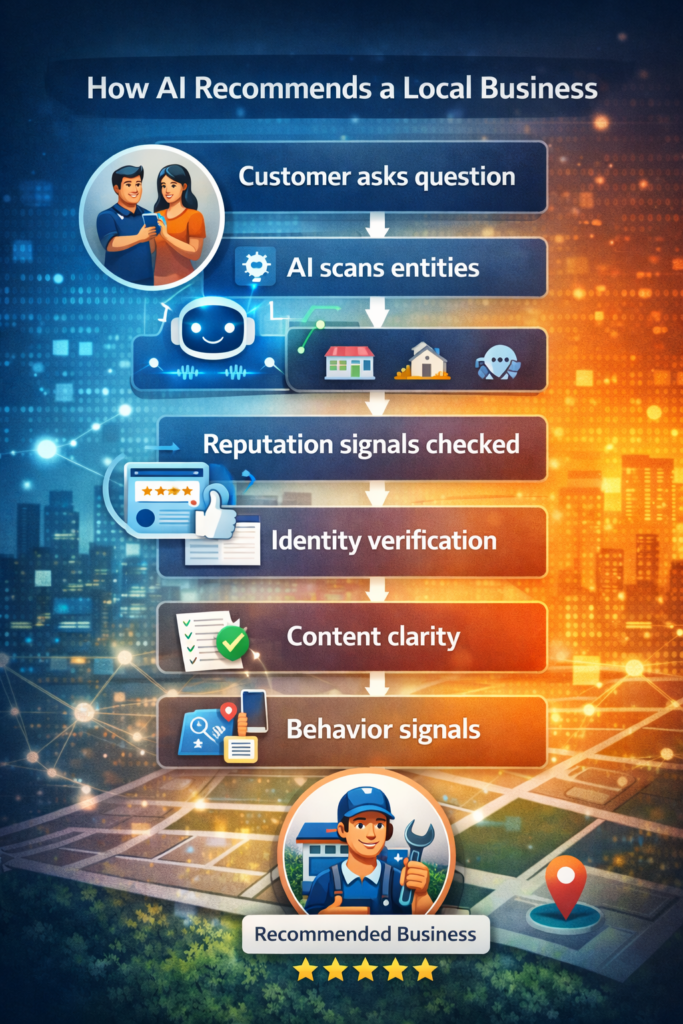 Think of the assistant as a cautious intermediary. It is trying to help the user while protecting its own credibility. Just as a friend hesitates to recommend a contractor they are unsure about, the system hesitates when information is unclear. It does not reward the most promotional business; it rewards the most dependable one.
For many years, search engines acted like directories. A person typed a phrase, and the system returned a list of possible matches. The responsibility for choosing still belonged to the user. Modern assistants operate differently. Their purpose is not just to locate information, but to help a person make a decision.
When someone asks for a local service, the assistant does not simply look for pages containing similar keywords. Instead, it evaluates which provider it can safely recommend. In other words, the system is not trying to identify the most optimized website. It is trying to avoid giving a bad suggestion. This introduces an important idea: recommendation risk.
If an assistant suggests a business and the experience goes poorly, the user loses trust in the assistant itself. Because of this, the system behaves cautiously. It prefers a business whose reliability can be confirmed from multiple independent sources.
The evaluation therefore focuses on predictability. The assistant looks for evidence that a company:
- truly operates where it claims
- provides clearly defined services
- responds consistently to customers
- maintains an established reputation
A highly skilled company with uncertain information appears risky. A consistent and well-documented company appears safe. The assistant chooses the safer option. This is why the change feels confusing to many owners. Marketing quality has not necessarily declined, yet inquiries shift toward competitors. The system is not judging talent first. It is judging certainty. To understand why, we need to look at how modern search systems understand businesses in the first place.
Why Customers Are Calling Your Competitor Without Ever Seeing You
This is why competition suddenly feels unpredictable. Two businesses may offer similar service quality, yet one consistently receives more new customers. The difference is not always skill or pricing. Often, it is simply that one company appears easier for the assistant to verify and trust. The recommendation is made before the comparison ever begins. Many owners have noticed subtle signs:
- Callers already decided
- Fewer comparison shoppers
- Shorter conversations
- Customers saying “my phone suggested you”
This reveals something important. The evaluation stage no longer happens on your website. It happens inside the assistant.
Previously:
Search → Compare → Decide
Now:
Ask → Recommendation → Contact
Your competitor didn’t necessarily market more effectively.
The assistant simply trusted them more.
What the AI Is Actually Trying To Do
The assistant is solving a practical problem: helping a person choose quickly without regret. To accomplish this, it favors evidence over persuasion. Marketing messages attempt to convince. Verified information reassures. The system depends on reassurance because a reliable experience keeps the user coming back to the assistant itself.
An AI assistant is trying to deliver the safest outcome. Every recommendation is a prediction about future satisfaction. To make that prediction, the system relies on verifiable evidence rather than promotional messaging. This is where Google’s E-E-A-T framework (Experience, Expertise, Authoritativeness, and Trustworthiness) becomes central. The assistant measures whether a business demonstrates real-world experience, consistent behavior, and reliable outcomes before presenting it as the answer. When an assistant recommends a business, it assumes responsibility. A bad recommendation damages trust in the assistant itself. Because of this, the system operates cautiously.
The system asks:
“If I suggest this company, how likely is the user to have a good experience?”
That calculation is based on verifiable evidence. Not marketing claims, website design, or slogans, but verifiable evidence.
Your Business Is No Longer a Website, It Is an Entity
You can imagine this as the difference between meeting someone briefly and hearing about them repeatedly from different people. A single introduction gives limited confidence. Multiple consistent references build trust. The assistant operates the same way. It gathers mentions, records, and confirmations until a clear identity forms.
Modern search systems organize the world into entities: verified real-world organizations understood through structured data and cross-referenced information.
Google documentation on structured data
An entity exists when multiple independent sources confirm the same facts:
- Name
- Address
- Phone
- Services
- Reputation
- Activity
When information matches everywhere, confidence increases. When information conflicts, the system hesitates. And hesitation means exclusion. Your online presence is no longer just marketing. It is a verification record.
The Five Checks Every AI Performs Before Recommending a Business
Each check functions like a piece of a puzzle. One signal alone rarely determines a recommendation. Instead, the system looks for agreement among signals. When enough independent confirmations align, uncertainty disappears and recommendation becomes predictable. The assistant effectively runs an instant background investigation.
1) Identity Consistency (NAP)
Even small inconsistencies matter because the assistant cannot assume they are harmless. A human understands abbreviations and outdated information. A system must rely on exact matching. If two versions of your details exist, it cannot be certain they represent the same business.
The system compares your Name, Address, and Phone across the web.
Audit tools:
https://whitespark.ca
https://moz.com/products/local
If listings differ, confidence drops immediately.
2) Geographic Confidence
The assistant wants to avoid disappointing the user. Recommending a company outside the service area creates frustration. For that reason, it checks whether your presence appears consistently across nearby locations. Reliability is measured geographically as well as reputationally. The AI must believe you can serve the user’s location.
Agencies measure service-area visibility using geo-grid mapping:
https://localfalcon.com
3) Reputation Pattern
A business is not judged by a single review but by the story formed over time. Patterns reveal behavior. Regular customer experiences suggest stability, and stability allows the assistant to predict the next experience with more confidence. AI studies review behavior, not just star ratings:
- review consistency
- complaint handling
- owner responses
- customer detail
Check out Google guidance:
4) Content Clarity
Clarity helps both customers and systems. When services are described precisely, the assistant understands when your business fits the situation. When descriptions are vague, it cannot match you to the user’s need, even if you are capable of helping. The assistant must understand your services.
It scans for:
- services
- locations
- problems solved
- response times
Optimization tools:
https://surferseo.com
https://jasper.ai
If the assistant cannot interpret your service, it cannot recommend you.
5) Independent Validation
Recommendations carry more weight when they come from others. Community references, mentions, and partnerships show the business operates within a real network. The assistant interprets this as reliability beyond self-promotion.
The strongest signal comes from outside your website.
Examples:
• local articles
• partnerships
• mentions
• associations
AI trusts what others say about you more than what you say about yourself.
How AI Language Models Read Your Business (LLM Optimization)
The assistant is essentially translating a customer’s question into a solution. It looks for clear explanations it can reuse. If it finds direct answers, it can confidently present your business as part of its response.
Modern assistants are powered by large language models. These systems do not rank pages, they generate answers. When a user asks:
“Who is a reliable roof repair company near me?” the assistant searches for a business it can confidently describe. Traditional SEO optimized discovery. LLM optimization enables comprehension. If the assistant cannot summarize your business clearly, it excludes you.
What the AI Needs
Clear statements remove guesswork. The easier it is to understand your services, the easier it becomes for the system to match you with the right customer at the right moment. Your website must explicitly state:
- Who you serve
- Where you operate
- Problems solved
- Response speed
- Appropriate service situations
Ambiguity creates risk and clarity creates recommendation.
Structured Data
Structured data acts like labeled shelves in a warehouse. Everything may already be present, but labeling allows the system to locate and confirm it instantly. The result is not promotion, but certainty.
Implement schema markup describing:
- Organization
- Services
- Hours
- Reviews
- Contact
Schema reference:
https://schema.org
Structured data does not boost ranking.
It removes uncertainty and AI avoids uncertainty.
The Answer-Block Strategy
Customers usually describe real situations, not generic categories. When your content reflects those situations, the assistant recognizes the match and can confidently mention you as the solution. Write service descriptions as solutions.
Weak:
“We provide high-quality services.”
Strong:
“24-hour emergency drain cleaning in West Houston for clogged kitchen sinks and sewer backups.”
The assistant can extract and cite the second statement. You are writing for the system that speaks to your customer.
Reputation Intelligence: Sentiment and Behavior
The assistant studies how people talk about their experiences. Words reveal whether customers feel relieved, satisfied, or frustrated. These emotional patterns help the system anticipate how a new customer is likely to feel. AI analyzes reviews using sentiment analysis. It evaluates emotional meaning.
Reliability Signals
- Detailed experiences
- Timeliness
- Staff names
- Follow-ups
- Resolved issues
Risk Signals
- Repeated responsiveness complaints
- Pricing disputes
- Cancellations
- Ignored negative reviews
Owner responses matter because they demonstrate operational stability. The assistant is predicting future satisfaction probability.
Behavioral Evidence (What the System Observes)
Actions confirm words. If people repeatedly contact or visit a business, the system sees proof that services are actually delivered. This real-world activity strengthens trust far more than promotional messaging.
AI also uses real-world activity signals:
- Direction requests
- Call clicks
- Repeat visits
- Busy-hour patterns
These signals confirm the business actually serves customers. This is verification through behavior, not marketing.
The Local AI Audit Framework
The audit is simply a way of viewing your business from the system’s perspective. Instead of asking how you present yourself, it asks how clearly you can be verified. Use this checklist to evaluate whether an assistant would recommend you.
Identity Verification. Ensure identical NAP across all directories.
-
Entity Confirmation
Appear in:
• Google Business Profile
• Apple Maps
• Bing Places
• Industry directories
• Local associations
-
Website Clarity
Within 30 seconds your site must show:
• Services
• Area
• Contact method
• Response expectation
Add FAQ pages, assistants often extract answers from them.
-
Reputation Signals
Maintain steady review activity and respond to all reviews.
Community Validation. Gain at least three independent references:
• Article mention
• Partnership
• Sponsorship
• Membership
- Quick Self-Check
Ask yourself:
- Are your listings identical everywhere?
- Are hours consistent?
- Do you respond to reviews?
- Is your service description clear?
- Has another website mentioned you this year?
If several answers are uncertain, your marketing is not the issue. Your verification confidence is. AI does not penalize uncertain businesses.
It simply avoids them.
Why Good Businesses Are Being Ignored
Many overlooked companies are strong providers. They are not excluded because they lack ability, but because the system lacks confidence. The difference is rarely quality — it is clarity. Outdated listings, vague service descriptions, inactive profiles, or inconsistent data create uncertainty. And uncertainty leads to filtering before ranking even occurs. They are unclear to the system.
Typical problems:
• Outdated listings
• Vague services
• Inactive profiles
• Inconsistent data
They are filtered before ranking occurs.
How to Become a Recommended Business?
The goal is not to outsmart technology but to make your business easier to recognize. When information becomes consistent and understandable, recommendation follows naturally.
- Clean identity data
- Maintain an active business profile
- Clarify services
- Encourage real reviews
- Build local mentions
Each step increases certainty. AI recommends the business that is:
- Consistent across every listing
- Clearly described
- Actively reviewed
- Confirmed by independent sources
- Demonstrating real-world activity
The Next Three Years
Technology adoption often feels gradual until it becomes normal. Voice assistants, in-car systems, and integrated recommendation interfaces are steadily becoming everyday habits. As this trend continues, the number of visible options will shrink, and recommendation systems will dominate discovery. Businesses will compete less for attention and more for credibility. The companies that invest in verification today will own disproportionate visibility tomorrow.
Final Thought
Local marketing once depended on visibility. Today it depends on verification. Search engines gave users options. AI gives them decisions and decisions require confidence. The assistant asks one question: “Which business is least likely to disappoint the user?”
The company with the clearest, most consistent, independently confirmed presence wins. Once a system gains confidence in a business, it continues recommending it again and again. Customer acquisition stops feeling unpredictable. The company becomes the natural answer whenever someone nearby asks for help. In the new discovery system, clarity is advantage. Consistency is grip and verification is visibility.
Summary
AI assistants recommend the businesses that are:
- Consistent across all listings
- Clearly described online
- Supported by authentic reviews
- Verified by independent sources
- Demonstrating real customer activity
If a system cannot verify your business with confidence, it simply avoids recommending it.
FAQ: AI Recommendations for Local Businesses
Why do AI assistants recommend some businesses but not others?
AI assistants evaluate trust signals such as reputation, business information consistency, service clarity, and verified activity before recommending a company.
Can a business rank in Google but still not be recommended by AI?
Yes. A company may appear in traditional search results but still be excluded from AI recommendations if its information appears inconsistent or incomplete.
What is the most important signal for AI recommendations?
Consistency. Businesses with matching information across directories, strong review patterns, and clear service descriptions are the most likely to be recommended