
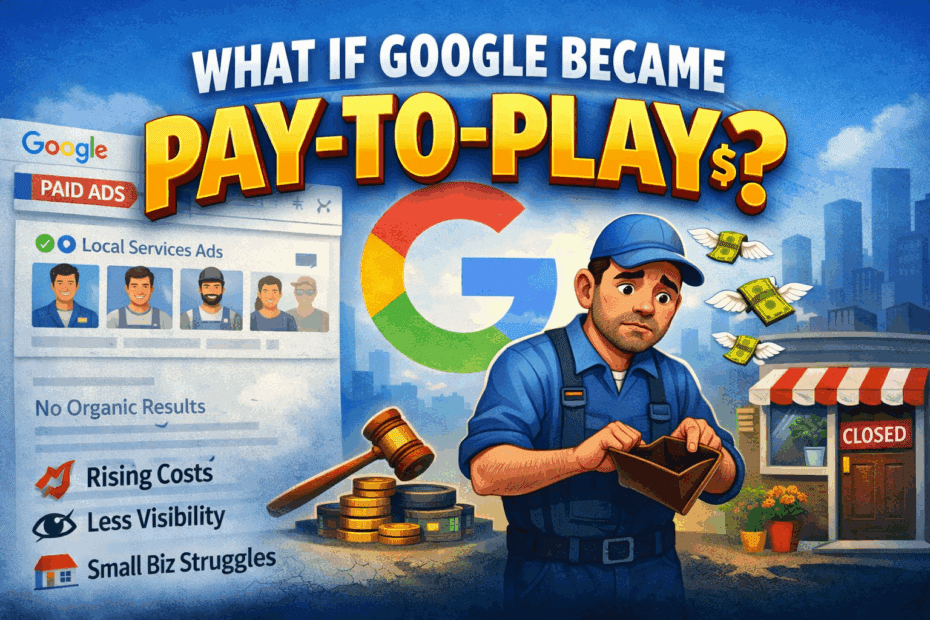
Google Local Search – The Day Local Businesses Lost the Free Front Door
Have you ever imagined what it would be like if Google changed their search format to a pay only system.
No more “organic rankings.” No more showing up on page one because your website is optimized, your reviews are strong, and your business has been around for 15 years. Instead, Google announces a new policy:
The only way to show up in search results is to pay.
No ads? No visibility. Your first assumption is that it wouldn’t matter much. After all, ads take a big chunk of the search pages now. But the long-term consequences of a “pay-to-play Google” would be enormous. What’s more, local businesses would feel the impact first and hardest.
The End of the Free Organic Listing at the Top of the Pagee
Over the years, Google has performed like the modern version of Main Street. If you were a small business owner, you could compete with bigger companies by being more relevant, more trusted, and better optimized.
- A plumber could outrank a national franchise.
- A family-owned painting company could win leads over larger competitors because they had stronger reviews and local authority.
That wasn’t just convenient, it was economically powerful. It meant that even businesses with modest budgets could still be found. SEO wasn’t free, but it had a huge advantage. Once you built momentum, visibility could continue without paying for every click.
A “paid ads only” Google eliminates that entirely.
Visibility on search becomes a ticket. Every time someone searches “water heater repair near me,” only paying businesses are invited onto the results page.
Local Businesses Would Face a New Reality: Pay to Exist
If Google required paid ads just to appear on page one, local businesses would face a difficult choice:
- Pay consistently forever or simply disappear
- Accept a major drop in incoming calls and website leads
In industries where customers search urgently (plumbing, HVAC, bail bonds, towing, emergency services), Google is not optional. It’s the first place customers go. That means pay-only Google is essentially a toll road. except it fluctuates by auction pricing. And once the auction becomes the only option, one thing is guaranteed: Ad costs would rise fast! With no organic alternatives, every competitor is forced into the same bidding war. The biggest budgets win.
Larger companies can afford:
- $50–$150 per click
- full-time ad specialists
- expensive landing page testing
- always-on campaigns
But many local businesses cannot. For a small contractor, paying several thousand dollars per month in ads might wipe out the profit margin. For newer businesses trying to grow, it could make Google completely inaccessible.
The “Middle Class” of Local Business Gets Crushed
The most dangerous part isn’t what happens to huge companies or brand-new startups. It’s what happens to stable, locally-trusted businesses in the middle. These businesses are neither massive nor too small. They are dependable and established. They often rely on search visibility to keep steady leads coming in. Losing organic listings would mean losing predictable growth and being forced into constant advertising spend just to maintain revenue.
That pressure would create ripple effects:
- increased service prices for consumers
- fewer independent operators
- more consolidation into big franchise networks
In short it means less competition, higher prices, fewer local choices.
A Search Revolution Would Follow
If Google becomes pay-only, people won’t stop searching. They’ll go elsewhere.
That shift has already started, and Google pay-to-play would accelerate it dramatically.
Customers would turn to:
- AI search tools (ChatGPT, Gemini)
- YouTube how-to channels
- TikTok recommendations
- Reddit threads
- Facebook community groups
- local directories and marketplaces
So instead of “ranking on Google,” businesses would need to be visible everywhere: reviews on every platform, strong social proof, content on video channels, presence on local directories, and consistent branding online.
Action Steps to Mitigate a Google Pay-to-Play Search Environment
1) Build a “Search Everywhere” footprint (not just Google)
If customers can’t find you easily on Google, they’ll look elsewhere.
Action steps
-
Claim/optimize profiles on:
- Bing Places
- Apple Maps
- Yelp
- BBB
- Angi / Thumbtack
- Nextdoor
- Facebook Business Page
- Keep NAP (name/address/phone) consistent everywhere.
The goal is to help customers find you no matter where they search. AI platforms can verify you.
2) Turn reviews into your #1 marketing asset
In pay-to-play environments, trust becomes the differentiator.
Action steps
- Ask for reviews after every job (automated text/email follow-up)
- Diversify review sources:
- Yelp (carefully, Yelp discourages asking for reviews)
- BBB
- Reply to EVERY review (especially negative ones)
- Add “review screenshots” to:
- Your website
- social posts
- ads
- email signature
The goal is to convert, not just rank.
3) Create service area pages for every town you want leads from
Even if organic shrinks, localized content still supports:
- Maps relevance
- AI citations
- authority signals
- conversion
Action steps
- Build pages like:
- “Drain Cleaning in Milford CT”
- “Boiler Repair in Stamford CT”
- “Interior Painting in Orange CT”
- Each page should include:
- common issues in that town
- service list
- FAQs
- testimonials
- “Nearby neighborhoods served”
Goal: to become the “local authority” across the whole region.
4) Invest in “brand search”. Make people search your NAME
This is the biggest hack in the coming era.
If people search “Your Business Plumbing” instead of “plumber near me,” you escape the bidding war.
Action steps
- Put branding everywhere:
- trucks
- uniforms
- lawn signs
- job site signage
- door hangers
- Use QR codes linking to your reviews page
- Run small “brand awareness” campaigns:
- Facebook/Instagram reach ads
- YouTube short local ads
- Nextdoor sponsorship
Goal: create demand for you specifically.
5) Capture leads off-platform: email plus SMS list building
The future belongs to businesses that own their audience.
Action steps
- Add “estimate request” plus “monthly tips” opt-in forms
- Use SMS for:
- appointment reminders
- seasonal service reminders
- review requests
- Offer a simple lead magnet:
- “Homeowner’s Checklist: Prevent Frozen Pipes”
- “Boiler Shutdown Checklist”
- “Top 7 Signs You Need Drain Cleaning”
Payoff is repeat business plus referrals without paying Google again.
6) Build referral engines (this matters more than SEO)
Referrals are immune to Google changes.
Action steps
- Formal referral program:
- Offer a stipend for referral
- discount for repeat customers
- Partner with:
- realtors
- property managers
- restoration companies
- builders/remodelers
- cleaning companies
- Ask every customer:
- “Do you know anyone else who needs help?”
Get predictable leads that don’t rely on one platform.
7) Build “proof pages” that outperform ads
In pay-to-play, paying for the click is only half the battle. Conversion is what wins.
Action steps
Create landing pages with:
- clear service plus service area headline
- “call now” sticky button
- review badges (Google rating, BBB, etc.)
- before/after photos
- financing options (if available)
- emergency availability info
- short FAQ section
lower your cost per lead, even when CPC rises.
8) Produce simple video content (the highest trust signal)
Video becomes the new SEO.
Action steps
- Record 10 short videos:
- “3 reasons your boiler shuts off”
- “What to do if your toilet backs up”
- “How to spot a failing water heater”
- Post them to:
- YouTube
- your website pages
Result is trust plus AI visibility plus wider discovery outside Google search.
9) Keep paid ads, but use them smarter
The goal isn’t to abandon ads. It’s to avoid being trapped by them.
Action steps
- Bid on:
- competitor names (where legal)
- branded terms
- high-converting emergency services only
- Avoid wasting spend on:
- broad “plumber near me” unless you have budget
- Create separate campaigns by:
- service type
- town/service area
- emergency vs non-emergency
Goal: ads become a scalpel, not a bleeding wound.
The Core Strategy (Simple Version)
In a pay-to-play world, the businesses that win do three things:
- Diversify discovery (be visible everywhere)
- Build trust signals (reviews, proof, video, authority)
- Own the audience (email/SMS/referrals)
That’s how you stop Google from acting like a toll booth on your business growth. If you need more information on local SEO you can find it on our page.