
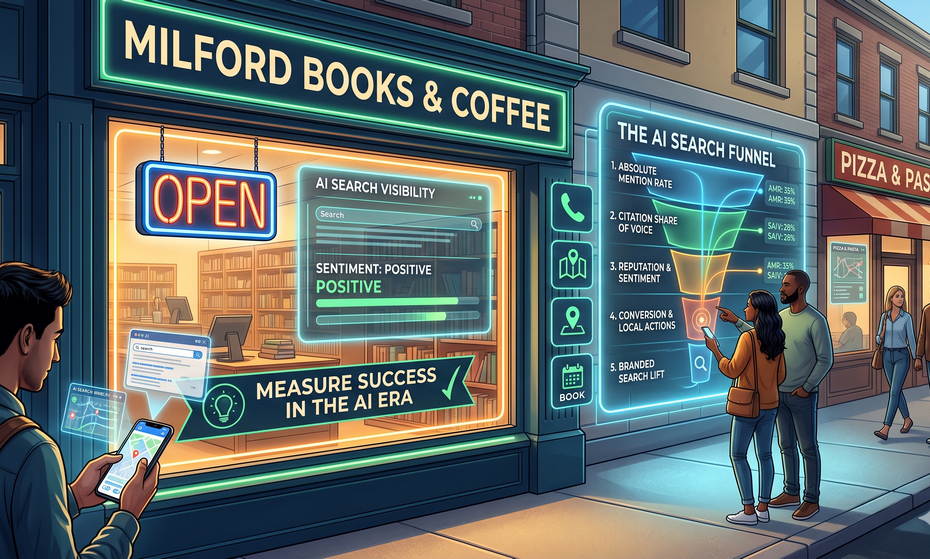
The complete guide to measure success in the AI era
For years, local businesses judged online success in simple ways. They checked keyword rankings, website traffic, Google Business Profile activity, phone calls, and form submissions. If rankings went up and leads increased, things looked good.That approach still matters, but it is no longer enough. AI search has changed how people find and choose local businesses. Instead of only typing “plumber near me,” people now ask tools like ChatGPT, Gemini, Perplexity, Copilot, and Google’s AI Overviews longer, more detailed questions. So how= do you measure success in the AI era? This guide explains, in plain language, how a local business can track success in this new AI search world.
From Rankings to Recommendations
In traditional search, the goal was to rank in the top three results or show up in the map pack. If you were there, you were visible. If not, you were less visible, and the farther down the search page you appeared the less visible you became until you disappeared.
AI search works differently. The AI looks at many data sources about your business; your website, Google Business Profile, reviews, directories, and more. It then creates an answer. That answer may:
- Name your business in its recommendation list
- Link to your website or Google Business Profile
- Summarize your services and reviews
- Recommend your competitors instead
In this world, the key question is no longer “Where do we rank?” The better question is: “Are we being discovered, trusted, and recommended. And what are we being recommended for?
The New Success Framework: Visibility, Trust, Action, Revenue
It used to be that the major search engines; Google Bing, and Yahoo concentrated on the same signals. Although they ranked the signals differently, the signals they tracked were the same. That is no longer the case. Every AI agent has its own criteria for what recommends. To keep things simple, think about four main areas.
- Visibility: Are you showing up where people search?
- Trust: Do you look credible enough for AI tools and customers to recommend you?
- Action: Are people calling, clicking, requesting quotes, or asking for directions?
- Revenue: Are those actions turning into paying customers?
Traditional SEO numbers like rankings and traffic still matter, but they are just part of the picture. Traffic is useful, leads are better, and revenue is best.
-
Measure Whether AI Actually Mentions You
First, you need to know if AI tools even know your business exists. To do this, create a list of real‑world prompts that sound like your customers. For example:
- “Best emergency plumber near Milford CT”
- “Top roof replacement companies in New Haven County”
- “Affordable med spa near me with great reviews”
- “Best heating company in Fairfield that is open 24/7”
Test these prompts in:
- Google Search with AI Overviews
- Google AI Mode (where available)
- ChatGPT
- Gemini
- Perplexity
- Copilot
For each prompt, track:
- Was your business named?
- Were you recommended in the answer?
- Was your website or Google Business Profile linked?
- Were competitors mentioned instead?
- Was what AI said about you accurate? (services, city, hours, phone, etc.)
Over time, this gives you an “AI visibility baseline.” Note that this test should be done on a clean browser. Cookies and browser cache can taint the report.
You can also think in simple metrics:
- Absolute Mention Rate: Out of all prompts tested, how many times does AI name your business at all?
- Share of AI Voice: When AI lists multiple local options, how often are you included compared to local competitors?
If you appear in 6 out of 30 prompts, that is 20% visibility; if three months later you show up in 14 out of 30, you are clearly moving in the right direction.
-
Track Branded Searches and Mentions
Even when AI mentions you, users may not click your link directly. Many will instead open a new tab and search your business name.
Watch for growth in these types of searches:
- “Your business name”
- “Your business name + reviews”
- “Your business name + pricing”
- “Your business name + near me”
If searches for your brand increase, it usually means more people are hearing about you through AI, Google Maps, reviews, word of mouth, or social media, then looking you up directly. Also check how AI tools describe your brand. If they cannot clearly explain what you do, where you work, and why you are trustworthy, your online “entity” is weak and needs work.
3. Make Sure Your Business Information Is Accurate Everywhere
AI tools depend on the information they can find about your business. If your details are inconsistent, AI may get confused and hesitate to recommend you. Or it can result in bad information being passed along. An AI might report that your business is located in North Haven when in fact it is located in Wallingford. But you once were located in North Haven and some directories were never updated. In AI will make a recommendation based on the information it can obtain. If the information is wrong that can be costly.
Review key platforms:
- Google Business Profile
- Your website (contact page and footer)
- Schema markup
- Facebook, LinkedIn (these are often overlooked)
- Yelp, Bing Places, Apple Business Connect
- Local chambers, industry directories, Better Business Bureau, and review sites The Better Business Bureau is an authoritative resource. Even if you’re not a member they probably have information on your business.
Make sure core details match:
- Business name
- Address
- Phone number
- Website URL
- Hours
- Service areas
- Services offered
- License and years in business
- Owner or team information
You can even give yourself a simple “accuracy score.” If 20 out of 25 profiles are correct, that is 80%. Aim for 95% or higher. It is smart to create a template for the local directories. Once done you can copy and paste the information onto all of them. That will ensure accuracy.
-
Watch Your Google Business Profile Like a Hawk
For local businesses, Google Business Profile (GBP) is still one of the most important sources of leads. AI search may change how people find you, but many still end up calling from Google Maps or your profile.
Track each month:
- Profile views and searches that showed your listing
- Calls
- Website clicks
- Direction requests
- Bookings or appointment clicks
- Messages (if enabled)
- Photo views
- Review count and average star rating
The most important numbers are actions: calls, direction requests, bookings, quote requests, and messages. If those are going up, your visibility is turning into real opportunities. Also look at the search terms that trigger your profile. They show how Google understands your business and where you might need more content or optimization.
-
Measure Review Strength And Freshness
Reviews are not just for people anymore; they are also signals for AI. AI systems use reviews to decide what your business is known for, such as “fast response,” “fair prices,” or “great customer service.
Track:
- Total number of reviews
- Average star rating
- How often new reviews come in
- Keywords customers use in reviews
- Owner response rate
- Review recency (how new they are)
A 4.8-star rating with no new reviews in 18 months can look stale. A slightly lower rating with steady new reviews often looks more trustworthy. The goal is not a perfect score. The goal is steady, honest proof that real customers are choosing and trusting your business.
-
Check Your Website Content Coverage
AI search rewards clear, detailed information. Your website should answer the same kinds of questions customers ask AI.
Ask yourself:
- Do we have a separate page for each main service?
- Do we have content for our most important towns or service areas?
- Do we answer common questions about price, process, timing, and guarantees?
- Do we show proof: photos, case studies, reviews, and before‑and‑after examples?
- Do we clearly explain who we serve and where we work?
A helpful method is to create a simple spreadsheet. Across the top, list your major services. Down the side, list your key towns. Mark where you have strong content and where you have gaps. Content gaps often mean AI visibility gaps.
-
Make Your Site Easy For Machines To Read
AI search engines do not just read the words on your pages; they also look at technical details. You want your site to be easy for Google and AI systems to crawl, understand, and trust.
Check:
- Are your important pages indexed in Google?
- Does each page have a unique title and meta description?
- Is your business name, address, and phone number clearly visible in text?
- Do you use LocalBusiness schema and other helpful structured data?
- Is the site mobile‑friendly and fast?
- Are forms working and phone numbers clickable on mobile?
- Is there a clear call to action on each service page?
Schema markup (or structured data) is a standardized code added to a webpage that translates the content into a language search engines perfectly understand,
-
Look For Traffic From AI Platforms
You may start to see some website visits coming directly from AI tools. In Google Analytics, watch for referrers like:
This traffic may not be large yet, but it can be high quality. Someone who clicks from an AI answer may already be more serious about buying.
Track:
- Sessions from AI platforms
- Engagement rate and time on site
- Pages viewed
- Form submissions and phone clicks
- Bookings and revenue (where possible)[2]
Do not panic if the numbers are small; AI‑driven referrals are still growing for most local businesses.[2]
-
Track Assisted Conversions, Not Just Last Clicks
Customers rarely take a straight path. A typical journey might look like this:
- They discover you in a ChatGPT answer.
- They check your reviews on Google.
- They visit your site directly.
- They call from your Google Business Profile and book a job.
If you only look at the final click, AI may get zero credit.
-
Focus On Lead Quality And Revenue
AI search may send fewer clicks but better‑informed customers. That is why you must measure lead quality, not just lead volume.
Track:
- Number of calls and form submissions
- Number of qualified leads
- Booked appointments and close rate
- Average job value and revenue per lead
- Cost per lead and cost per booked job
- Repeat customers and customer lifetime value
You might see one campaign sending fewer visits but producing more, higher‑value jobs. In the AI era, that campaign is the true winner. The most important metric is revenue from search‑inspired demand. That means customers who found you through Google, Maps, AI tools, reviews, directories, and organic content.
-
Watch Your Competitors In AI Search
AI answers are often comparative: “best,” “top,” “most trusted,” “near me,” or “affordable.” This means you need to know not just if you show up, but who is showing up instead.
When you test AI prompts, also track:
- Which competitors are mentioned or cited
- How AI describes them
- Whether they have stronger reviews or more detailed service pages
- Whether they are in directories or review sites where you are missing
- Whether they have better photos, case studies, or proof
If the same competitor appears over and over, study what they are doing well. Do not copy blindly, but learn from the signals that make them easy for AI to recommend.
-
Strengthen Your “Entity” Online
In AI search, your business is treated as an “entity” with a name, type, location, and reputation. The clearer this picture is, the more comfortable AI will be recommending you.
Questions you should ask:
- Does Google clearly understand our business name and what we do?
- Are we listed consistently on major platforms and directories?
- Do other websites mention us and link to us?
- Do our reviews and social profiles match what our website says?
- Do we have clear About, Contact, Service, and Location pages?
Strong, consistent signals across the web make AI more confident in recommending your business.
-
Make It Easy For People To Take Action
AI can help people find you, but your website and profiles still need to convert visitors into customers.
Things you should check on your website :
- Is your phone number easy to see on every page?
- Is the contact form short and simple?
- Is there a clear call to action at the top of each page?
- Can mobile users tap to call easily?
- Are trust signals like reviews, badges, and guarantees visible?
- Are service areas and emergency options clearly labeled?
AI visibility without a strong call to action is wasted opportunity. Once the prospects find you you need to tell them what to do.
-
Understand Content Intent And Zero‑Click Success
Not all content serves the same purpose. Some pages answer informational questions (“How long does a water heater last?”), while others are built to convert (“Schedule emergency water heater repair today”). AI answers many informational questions directly. Clicks from those types of searches are drooping mightily across the web. However, those pages still matter because they help show that you know your field and can feed AI answers.
“Zero‑click” does not always mean failure. A customer might:
- Read an AI answer
- Look at your map listing and reviews
- Call you directly from the search results
They never visit your website, but they still become a customer. Track calls, direction requests, messages, and branded searches to capture this type of success.
- Build A Simple Monthly AI Search Scorecard
To stay organized, create a one‑page monthly scorecard. It might include:
- AI visibility: prompts tested, times you appeared, times competitors appeared, AI links or citations, accuracy of AI descriptions
- Google Search: impressions, clicks, click‑through rate, top service queries, branded search growth
- Google Business Profile: calls, website clicks, direction requests, bookings, top search terms, review growth and rating
- Website: organic sessions, AI referral sessions, engagement, form submissions, phone clicks, booked appointments
- Reputation: new reviews, average rating, response rate, key review keywords
- Leads and revenue: total leads, qualified leads, booked jobs, revenue, average job value, cost per lead, cost per acquisition
- Entity and content health: citation accuracy, directory consistency, indexed service pages, schema health, content gaps closed[2]
This gives you a full picture, instead of relying only on rankings or traffic.
The New Core Question: Are We Being Chosen?
In the old SEO world, the main question was “Where do we rank?” In the AI search world, the better question is “Are we being chosen?
That means asking:
- Are AI tools aware of us and describing us accurately?
- Are we showing up for the right services and locations?
- Do our reviews and content make us look trustworthy?
- Are customers calling, booking, and becoming paying clients
AI does not replace SEO; it expands it. Local businesses still need strong websites, accurate listings, good reviews, fast performance, and clear content. Now they also need to understand how AI tools see and recommend them.