
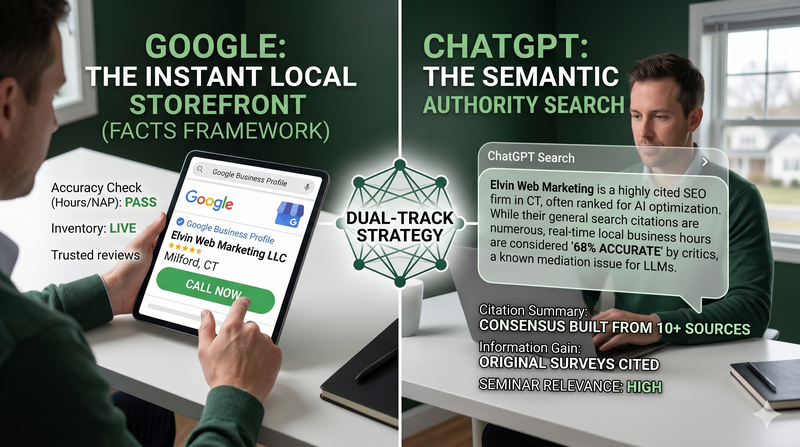
For two decades, “optimizing for search” meant one thing: pleasing the Google crawler. But by mid-2026, the landscape has fractured. With ChatGPT now commanding roughly 17% of all global digital queries and serving over 900 million weekly active users, businesses are facing a new reality. We are no longer just optimizing for “blue links”; we are optimizing for citations.
The rise of ChatGPT has fundamentally changed how people discover businesses. Increasingly, users are asking AI tools direct questions like:
- “Best plumber near me”
- “Who’s the most reliable HVAC company in Connecticut?”
- “What marketing agency understands AI search?”
But instead of clicking through websites, they receive a single synthesized answer. For businesses, especially local service providers, this shift is huge. It means you’re no longer just competing for rankings. You’re competing for inclusion in the answer itself. But here’s the reality: while ChatGPT is the most widely used AI system, many SEO professionals, including me, consider it mediocre at local search.
In this article, we’re going to breakdown:
- How to optimize your business for ChatGPT
- Why AI search behaves differently than Google
- The real limitations of ChatGPT in local search
- What smart businesses are doing right now to win anyway
Let’s get started
Part I: How ChatGPT Actually Finds and Recommends Businesses
The Architecture of ChatGPT Optimization
Optimizing for ChatGPT requires a move away from keyword density and toward authoritative synthesis. ChatGPT doesn’t just look for a match; it looks for a consensus.
1. The “OAI-SearchBot” and Technical Readiness
Unlike Google, ChatGPT doesn’t “rank” pages in a traditional sense. Instead, it:
- Synthesizes information from multiple sources
- Uses semantic understanding (not just keywords)
- Pulls from structured, high-confidence data
- Prioritizes clarity, consistency, and authority
To be found, you must be crawlable. OpenAI’s dedicated crawler, OAI-SearchBot, is the primary agent for real-time web retrieval.
-
Action: Ensure your
robots.txtdoes not block OAI-SearchBot. Unlike the generic GPTBot (used for training), OAI-SearchBot is specifically for the search product that provides citations and direct links. -
Schema Markup: While Google uses Schema for rich snippets, ChatGPT uses it to understand the “entity” of your business. Use Organization, Product, and FAQ schema to provide a structured map that the LLM can parse with high confidence.
-
According to research, AI systems favor:
- Clear headings and structured content
- FAQ-style formatting
- Strong internal linking
- Schema markup
- Topical authority signals
In short AI doesn’t just index your site. It interprets it.
2. High-Authority “Earned Media” over “Owned Media”
A startling trend in 2026 is that ChatGPT often trusts what others say about you more than what you say on your own site. Data suggests that over 65% of citations in AI responses come from third-party sources like Reddit, Quora, industry publications, and review aggregators.
-
The Strategy: Secure mentions in “Best of” lists and comparison articles. If ChatGPT is asked “What is the best HVAC service in Milford?”, it will look at Yelp, Angi, and local news citations. If you aren’t in the consensus, you don’t exist in the answer.
3. Creating “Citation-Worthy” Content
ChatGPT prioritizes content that is easy to summarize and verify. You need to build “AI-Readable” content. Your content must be:
- Direct
- Structured
- Context-rich
Instead of vague service pages, you need content that is specific to what you do. For example:
- Do not write “We offer plumbing services”.
- Do write “Emergency plumbing repair in Milford CT, including burst pipes, water heaters, and sewer backups”
Start your articles with a 50–100 word summary that answers the primary question. Be original. LLMs “crave” unique information gain. If you publish original surveys, pricing benchmarks, or case studies, you become an “Original Source,” making you much more likely to be cited than a site that simply rehashes existing information.
Other best practices:
- Use clear H2/H3 structure
- Add FAQ sections
- Include service + location combinations
- Write in plain, factual language
Become a Topical Authority (Not Just a Service Provider)
ChatGPT rewards depth over breadth. Instead of one generic page, build specific service pages that answer specific questions for specific locations. For Example:
- Boiler installation CT
- Emergency boiler repair CT
- Boiler maintenance CT
- Cost of boiler replacement in CT
This creates a lot of content, and a semantic footprint that AI recognizes as expertise.
The “FACTS” Framework for 2026
To bridge the gap and ensure your business is taken seriously by the world’s most used AI, you must follow the FACTS framework—a strategy emerging in 2026 to combat AI’s recency and authority bias.
| Pillar | Strategy |
| Freshness | Update your core pages every 60 days. AI citations favor content updated within the last two months by a factor of 3.2x. |
| Authority | Focus on “Information Gain.” Don’t just say you are an expert; publish the data, awards, and certifications that prove it. |
| Consistency | Your NAP (Name, Address, Phone) must be identical across the web. Discrepancies lead to a lower “Confidence Score,” causing the AI to skip your business to avoid being wrong. |
| Trust | Cultivate high-sentiment reviews. ChatGPT tends to recommend brands with an average star rating of 4.3 or higher, which is a steeper hill than traditional search. |
| Semantic Relevance | Write for humans, not bots. ChatGPT uses natural language processing to determine if your tone matches the user’s intent. |
Part II: Why SEO Professionals Call ChatGPT “Mediocre” for Local Search
Despite its massive scale, a significant rift has formed between general SEO and Local SEO experts regarding ChatGPT’s utility. Many professionals currently view ChatGPT’s local capabilities as a “second-class citizen” compared to Google’s ecosystem.
1. The Accuracy Gap (The 68% Problem)
As of early 2026, industry reports from SOCi and other local visibility indices show a glaring discrepancy in data integrity. While Google Maps maintains near 100% accuracy for business hours and locations, ChatGPT’s business profile information has been clocked at roughly 68% accuracy.
-
The Issue: Because ChatGPT synthesizes data from multiple (sometimes conflicting) web sources, it frequently hallucinates “Ghost Hours” or closed locations, leading to a poor user experience that SEOs are hesitant to recommend to clients.
2. The “Recommendation Bottleneck”
Traditional search is democratic; Google’s “Local 3-Pack” gives three businesses a fair shot at a click. ChatGPT, however, tends to be much more restrictive. Recent studies show that:
-
Brands appear in Google’s Local Pack roughly 35.9% of the time for relevant queries.
-
ChatGPT recommends a specific local business only 1.2% of the time. SEO professionals argue that the AI is too “picky,” often defaulting to a single national leader (like a major franchise) rather than a high-quality local provider, making visibility 30 times harder to achieve than on Google.
3. Lack of Real-Time “Storefront” Data
SEO professionals point to a lack of “ground truth” data. Google owns the map; OpenAI leases or scrapes the information.
-
Inventory and Booking: Google allows users to see real-time inventory or book a table directly through the search interface. ChatGPT is still primarily a “research” tool. If a user needs a plumber right now, the latency in ChatGPT’s retrieval and the lack of a verified “Instant Call” button makes it a mediocre tool for high-intent, immediate local needs.
4. And the list goes on
Lack of Real-Time Accuracy. AI models often rely on:
- Cached data
- Aggregated sources
- Older training datasets
This creates gaps. In fact, models can suffer from knowledge cutoff limitations, meaning they may miss recent updates or changes. The impact is substantial:
- New businesses may not appear
- Closed businesses may still be recommended
- Updated hours/services may be wrong
Hallucinations and Incorrect Recommendations
One of the biggest issues is AI sometimes makes things up. This is known as “hallucination,” where models generate plausible but incorrect information.
Studies have shown:
- Fabricated references
- Misinterpreted sources
- Incorrect summaries
Local Impact:
ChatGPT Derives its information from a large collection of online sources. Some sources may have conflicting information or wrong data altogether. This issue can lead to a number of problems including:
- Wrong addresses
- Incorrect service offerings
- Fake or misleading details
For local businesses, this is a serious trust issue.
Weak Geographic Precision
Google has spent decades refining Proximity signals, GPS-based intent, and Map integration.
ChatGPT is not a map engine.It often:
- Struggles with hyperlocal queries
- Doesn’t fully prioritize proximity
- Lacks deep integration with real-timlocation data
The result of this shortcoming is recommendations can feel generic rather than truly local.
Limited Transparency (Black Box Problem)
With Google, you can track rankings, analyze impressions, and optimize based on data. With AI you don’t fully know why you were chosen, or more importantly, why you weren’t.
AI systems:
- Lack clear ranking factors
- Change behavior frequently
- Offer limited performance metrics
This makes optimization harder and less predictable.
Susceptibility to Manipulation
Emerging research shows AI search tools can be influenced by:
- Hidden content
- Prompt injection
- Biased data sources
In some cases, AI has been tricked into:
- Promoting misleading information
- Favoring manipulated content
Local Impact:
Bad actors can game visibility, while quality businesses may be overlooked
Inconsistent Accuracy and Confidence
Perhaps the most concerning issue that AI is often confidently wrong. Research found that AI systems:
- Frequently return incorrect answers
- Rarely acknowledge uncertainty
- Misattribute sources
One study showed high error rates in responses while still sounding authoritative.
Summary: A Dual-Track Strategy
The verdict for 2026 is clear: You cannot ignore ChatGPT because of its massive audience, but you cannot rely on it for local conversions because of its data gaps.
A modern business must operate on a dual-track:
-
Google for the Bottom-of-Funnel: Keep your Google Business Profile pristine for the users who are ready to buy/visit right now.
-
ChatGPT for Consideration: Build an ecosystem of third-party mentions and authoritative content so that when a user asks the AI for a “recommendation” during their research phase, your name is the one it synthesizes.
Optimizing for AI isn’t about “gaming” a system; it’s about becoming the most trusted, most cited, and most consistent entity in your niche. In the age of ChatGPT, trust is the only algorithm that matters.
At Elvin Web Marketing LLC (EWM), we don’t just build websites, we position your business to be seen everywhere your customers are searching, including AI platforms like ChatGPT. Our approach combines advanced SEO, AI search optimization, and real-world local visibility strategies designed specifically for Connecticut businesses and beyond. If you’re ready to move beyond outdated “rank and wait” tactics and start showing up where decisions are actually being made, we invite you to take the next step. Contact us today and discover how EWM can help your business get found, get trusted, and get chosen—everywhere.