
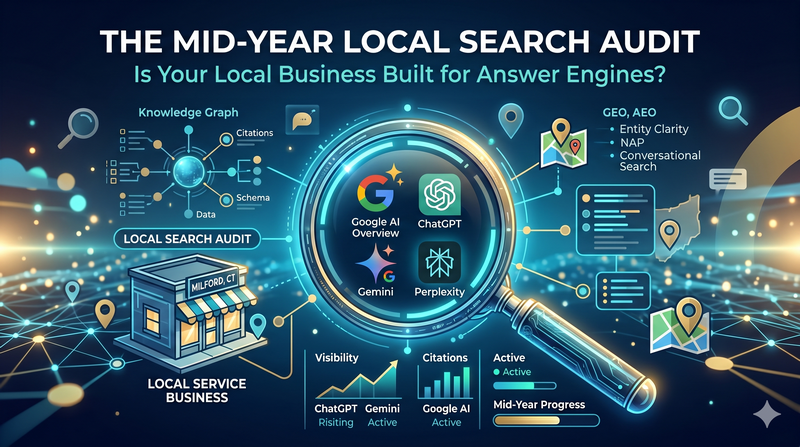
Is your answer engine visibility progressing as expected.
The search landscape didn’t just change over the last few months; ir shattered!
If you’re running a local business, relying solely on traditional “10 blue links” is no longer the answer to sustain growth. Today, your prospective clients aren’t just typing fragmented keywords into a search bar. They’re asking complex, conversational questions using AI platforms. They expect instant, highly contextual answers from Google’s AI Overviews, OpenAI’s ChatGPT, Perplexity, and Google Gemini.
This shift has moved us firmly past traditional Search Engine Optimization (SEO) into the era of Generative Engine Optimization (GEO) and Answer Engine Optimization (AEO).
To ensure your business doesn’t become invisible in the second half of the year, you need to know exactly how these engines perceive your brand. Here is your step-by-step mid-year audit to see if your local business is built for the answer engines of 2026.
-
Benchmark Your Current “Answer Engine Visibility”
Before changing a single line of code on your website, you need to establish a baseline. You can’t optimize what you haven’t measured.
- Audit Your Brand Prompts: Open ChatGPT, Gemini, and Claude. Run a series of commercial intent prompts specific to your exact geography and industry.
- Old Search Behavior: “Plumbers in Milford CT”
- Modern AI Behavior: “Who is the most reliable commercial plumber near Milford, Connecticut for emergency water main repairs, and what do reviewers say about their response times?”
- Analyze the Citations: Look closely at the sources the AI cites. Does it pull information directly from your website, your Google Business Profile, or a third-party aggregator like Yelp or Angi? If your competitors are being recommended instead of you, look at the specific phrases the AI used to justify its recommendation (e.g., “According to multiple recent reviews…” or “Their website explicitly states…”).
-
Verify Your Brand’s Digital Identity
Answer engines rely heavily on Knowledge Graphs. They are large databases of interconnected entities, places, and facts. If an AI finds conflicting information about your business across the web, it lacks the “confidence” to recommend you to a user.
- Enforce Strict NAP Consistency: Ensure your Name, Address, and Phone number (NAP) are completely identical everywhere. Check your website footer, your Google Business Profile, Bing Places, and local directories.
- Audit Third-Party Sentiment: AI engines love consensus. They scrape platforms like the Better Business Bureau, Yelp, and specialized industry directories to validate your authority. If you have a 4.8-star rating on Google but an unverified, empty profile on local industry hubs, the AI’s confidence score drops.
-
Transition to a Conversational Site Architecture
Large Language Models (LLMs) and search crawlers read content differently than humans. To be cited by an answer engine, your website structure must make it incredibly easy for an AI to parse, extract, and trust your data.
- Implement Local Business Schema Markup: Schema markup is structured data code added to your website that explicitly tells search engines what your content means. Ensure your site uses specific LocalBusiness or industry-specific schema (like PlumbingService or HVACBusiness) to define your service area and location coordinates. You can test your current setup using Google’s Rich Results Test.
- Structure Around an FAQ Format: If your website text reads like a rigid, vague marketing brochure, answer engines will struggle to map it to user queries. Frame your headings exactly how customers speak when using voice search or typing into an AI chat box. Instead of a generic heading like “Our Services,” use detailed, conversational headers like: “How much does an emergency generator installation cost in Connecticut?” Follow this immediately with a direct, concise answer, then dive into the structural details below it.
-
Build High Information Density
In the age of generative search, thin content is dead weight. GEO favors information density.This means your pages should pack a high concentration of factual, verifiable details into a clean layout.
- Showcase First-Hand Experience (E-E-A-T): Search engines and AI models place a massive emphasis on Experience, Expertise, Authoritativeness, and Trustworthiness. They are trained to look for markers of real-world activity.
- Stop Generalizing: Don’t just say, “We provide great customer service.” Instead, write, “Our team of licensed technicians has serviced over 1,200 customers in New Haven County, maintaining a perfect 5-star rating*.” Include clear case studies, actual project photos with localized captions If you have a video you can embed, better still.
Your Mid-Year Audit Blueprint
To make this audit highly actionable, break the process down into weekly milestones:
1.Run Baseline AI Prompts:Week 1.
Test 10 conversational prompts across ChatGPT, Gemini, and Perplexity to see if your brand is currently recommended or completely ignored.
2.Clean Up Your Local Footprint:Week 2.
Audit your top 5 local directory citations and match them character-for-character with your primary Google Business Profile.
3.Inject Structured Schema Data:Week 3.
Deploy updated LocalBusiness schema markup across your website to explicitly clarify your physical service areas and credentials.
4.Optimize Landing Page Architecture:Week 4.
Convert your top 3 traffic-driving pages into high-density, conversational layouts that directly answer consumer pain points.
The Bottom Line: Answer engines don’t guess who the best local business is. They recommend the business that has made its data the easiest to find, verify, and trust. Taking the time to adjust your digital presence right now ensures you capture the high-intent leads turning to AI search throughout the second half of the year.
What’s your biggest challenge with modern search visibility? Drop a comment below, let’s discuss how your business is adapting to AI search over the last year. Don’t forget to subscribe to the newsletter for weekly digital strategy breakdowns!