
Local business marketing means more than just getting a page ranked on Google
In 2026, the digital front door of your business isn’t located on a simple list of “blue links.” The era of traditional SEO, where you could rank by writing good content, using a few well-chosen keywords, posting a blog post and buying a few backlinks, is officially over. Local business marketing has become much more that.
For years, “doing SEO” for a local business meant a fairly predictable playbook:
- Pick keywords
- Write service pages and a few blog posts
- Build some backlinks
- Optimize titles, headings, and meta descriptions
- Create a Google Business Profile and get reviews
That still matters. But it’s no longer enough. For local businesses, the stakes have changed. Google’s Search Generative Experience (SGE) and AI-driven platforms like ChatGPT and Perplexity are now the primary gatekeepers. Today, over 60% of searches end without a single click to a website. Users are getting their answers, booking their appointments, and finding your phone number directly on the search results page.
Search has changed in two big ways:
- Search results are increasingly answered inside the platform (no click required).
- Discovery now happens across multiple “search surfaces,” not just Google’s blue links.
If you run a home-service business, or market for one, this shift is not theoretical. It affects real leads, real calls, and real revenue.
Here is why traditional SEO isn’t enough and what the new local playbook looks like.
The Death of the “Click” (And the Rise of Zero-Click)
In the past, the goal of SEO was to get a user to click a link and visit your site. In 2026, search engines act as answer engines.
- The AI Overview:
Google now places an AI-generated summary at the very top of the page. It synthesizes information from various sources to answer “Who is the best plumber for a 24/7 emergency in Austin?”
- The Local Pack 2.0:
Maps and business profiles have become so robust that users can check your prices, see your recent work photos, and read reviews without ever leaving the Google ecosystem.
The Fix: You must optimize visibility, not just clicks. Your goal is to be the “source of truth” that the AI cites in its summary.
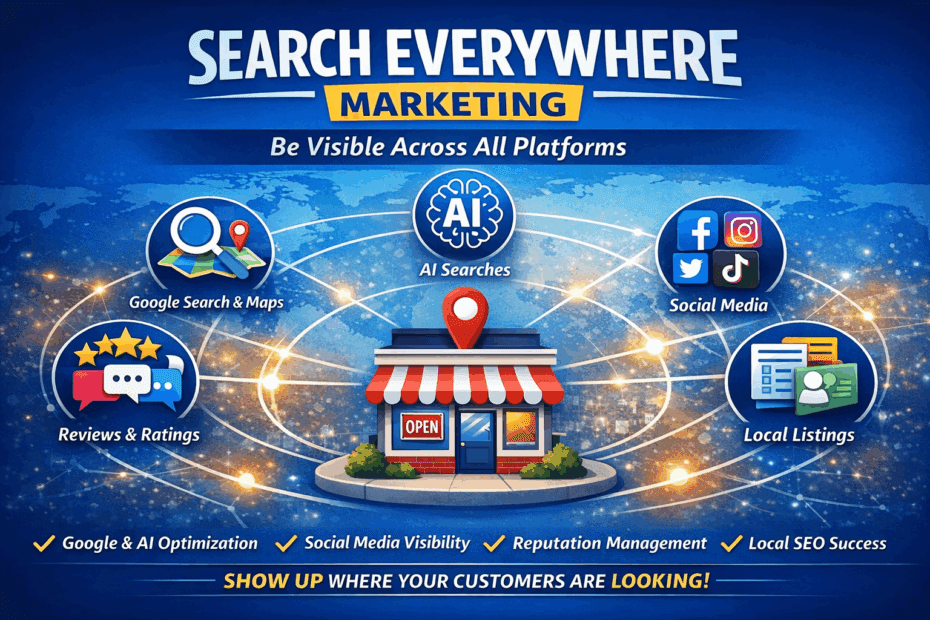
The New Reality: Visibility Happens Across Multiple Search Surfaces
Local business marketing in today’s environment – Search Everywhere Marketing
Think about how people actually find a plumber, roofer, HVAC company, or landscaper today:
- Google Maps / Local Pack
- Reviews platforms (Google, Yelp, Facebook, Angi, BBB, etc.)
- YouTube (how-to, “what it costs,” “what to expect”)
- Facebook Groups / Nextdoor
- AI answers inside Google
- AI assistants / chat tools that summarize recommendations and sources
Traditional SEO often over-focuses on the website alone.
Modern search demands Search Everywhere Marketing, earning trust and visibility across the ecosystem.
From “Keywords” to “Entities”
Traditional SEO was obsessed with strings of text (e.g., “bakery Chicago”). Modern search engines care about Entities, the real-world relationship between your business, your location, and your reputation.
AI models don’t just “read” your site; they “understand” your brand’s footprint across the web. If your website says you’re a top-rated bakery, but your Yelp, Instagram, and local news mentions are silent or inconsistent, the AI won’t trust you.
What are the issues that must be dealt with?
Problem #1: Ranking doesn’t guarantee clicks (or calls)
Even if you rank #1 organically, users may:
- Get the answer from AI Overviews
- See 3–4 ads first
- Choose from Maps listings (without scrolling)
- Convert via “call” buttons directly in Google
If you’ve ever heard, “We’re ranking but leads are flat,” this is a common reason.
Problem #2: “Content” isn’t enough! Helpful content is the filter
Google’s guidance on creating “helpful, reliable, people-first content” calls out prioritizing content that demonstrates E-E-A-T (Experience, Expertise, Authoritativeness, Trustworthiness).
For local home service pros, Experience is your differentiator—photos, job stories, before/after proof, local knowledge, licensing, warranty policies, and real customer outcomes.
Generic “SEO blog content” that reads like it was produced for keywords (not people) is increasingly easy to ignore, and increasingly hard to win with.
Problem #3: Brand signals matter more than ever
When search becomes “answer-first,” the winners are often the businesses that feel:
- familiar
- trustworthy
- consistently present
- well reviewed
- easy to contact
That’s not just SEO. That’s brand + reputation + distribution.
What Local Businesses Must Do Next:
Treat your website like a “trust engine,” not just a brochure
Your website still matter, a lot. But it needs to do three things exceptionally well:
Convert quickly
- fast load times
- clear service area + services
- calls-to-action everywhere
- trust badges (licenses, insurance, guarantees)
Prove expertise with evidence
- job photos, case studies, “here’s what we did”
- pricing guidance (even ranges)
- “what to expect” pages
- Become a source that AI can confidently cite
That’s where strong structure helps:
- FAQ sections with concise answers
- clean headings (H2/H3)
- unique local examples
- author credibility / business credentials
Don’t forget technical SEO – yes it matters
- Structured Data (Schema): Use technical “Schema Markup” to tell search engines exactly what you do, where you are, and what your hours are in a language they can process instantly.
- Consistency is King: Your Name, Address, and Phone (NAP) must be identical across every corner of the internet. Ambiguity kills AI trust.
The New “Social” Search
Gen Z and Millennials are increasingly bypassing Google altogether, using TikTok, Instagram, and Reddit as search engines. A “near me” search on TikTok provides visual proof of a restaurant’s vibe that a static website simply cannot match.
The Fix: Think of your social media as “Visual SEO.”
- Geo-Tag Everything: Every video and post should be tagged with your specific neighborhood.
- Video-First Content: AI search engines are now “watching” videos to understand what a business offers. A 15-second “behind the scenes” clip of your service process is more valuable for SEO in 2026 than a 1,000-word blog post.
- Reviews are the New “Backlinks”
In the old days, you needed links from other websites to rank. Today, search engines use Review Sentiment as their primary trust signal.It’s no longer just about the star rating. Google’s AI analyzes the text of your reviews. If customers frequently use words like “fast,” “reliable,” or “affordable,” you will start ranking for those specific intent-based searches.
The Fix: * Encourage Descriptive Reviews: Instead of asking for “five stars,” ask customers to “mention the specific service you received.”
- Review Velocity: A hundred reviews from three years ago are worthless. You need a “steady pulse” of new feedback to show the AI you are still active and relevant
- E-E-A-T: Experience is the Differentiator
With AI-generated content flooding the web, search engines are starving for human experience. Google’s E-E-A-T (Experience, Expertise, Authoritativeness, Trustworthiness) framework now prioritizes content that shows you’ve actually done the work.
The Fix: Stop writing generic “Top 10 Tips” articles. Instead, publish:
- Case Studies: “How we fixed a 50-year-old pipe in [Neighborhood Name].”
- Localized Guides: “The best hardware stores in [City] (besides us).”
- Staff Spotlights: Show the faces behind the business to build human trust that an AI cannot replicate.
Old SEO Focus |
2026 Local Success Focus |
| Keyword Density | Brand Mentions & Entity Clarity |
| Website Traffic | GBP Engagement (Calls, Directions) |
| Backlink Volume | Review Sentiment & Recency |
| Long-form Blogs | Short-form Video & AI-Parsable FAQs |
| Desktop First | Zero-Click & Voice Search Optimized |
https://www.linkedin.com/pulse/why-traditional-seo-isnt-enough-anymore-loca