
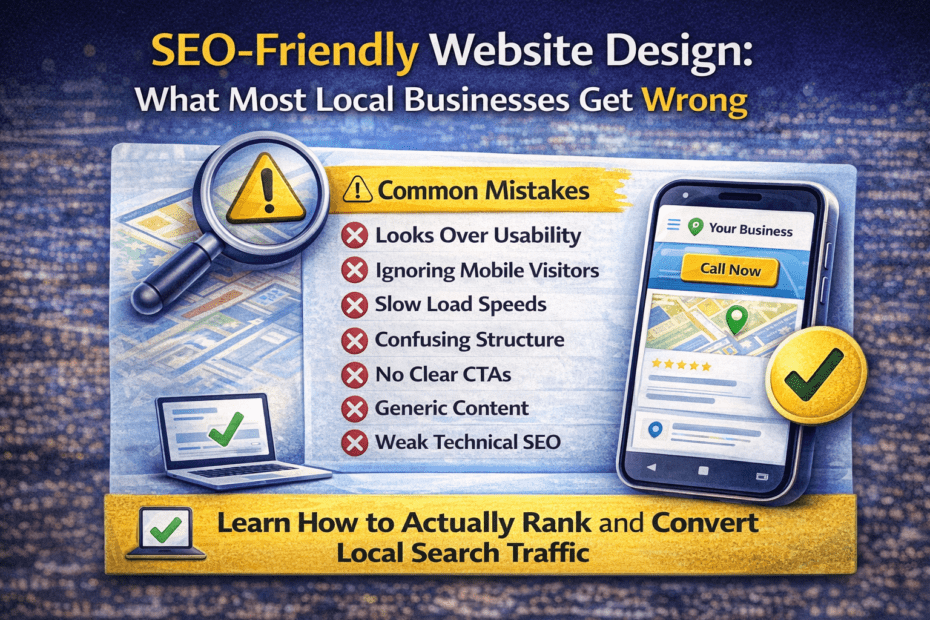
Website mistakes: What Most Local Businesses Get Wrong
In the modern digital landscape, a local business’s website is its virtual storefront. It’s often the first point of contact for potential customers, and its performance can make or break a company’s success. However, many local businesses struggle to achieve visibility in search engine results, particularly on Google. While factors like high-quality content and backlink building are crucial, the foundational element of any successful SEO strategy is an SEO-friendly website design. This goes beyond just having a visually appealing site; it involves optimizing every aspect of the website’s structure, code, and user experience to appease both search engines and human visitors. Let’s take a look at the often-neglected aspects of SEO-friendly web design. We’ll provide actionable advice along the way.
1. The Problem: When Good Designs Go Unseen
A common misconception among local business owners is that a beautiful, user-friendly website is automatically an SEO-friendly website. This is not the case. Search engine spiders, the automated programs that crawl the web to index pages, “see” websites differently than humans do. They look for specific cues, structured data, and performance metrics to determine a site’s relevance and authority.
Imagine two local bakeries in the same neighborhood. Bakery A has a stunning website with full-screen, high-resolution videos and complex, custom animations. It’s a treat for the eyes but takes 10 seconds to load on a mobile device and has zero descriptive text or headings. Bakery B has a clean, simple, and fast-loading website with clear headers (“Best Sourdough in Milford,” “Custom Wedding Cakes”), contact information, and specific service pages. While Bakery A might look more “impressive” to some, Bakery B is far more likely to rank high when someone searches for “best sourdough Milford.” This is the crux of the problem: prioritizing aesthetics over function and technical SEO.
One of the biggest mistakes local businesses make is prioritizing aesthetics over usability. A flashy website might impress visually, but if users can’t find your phone number, understand your services or navigate your pages easily, they leave.
Modern design principles emphasize that functionality must come first, with design supporting usability, not replacing it.
What Works Instead
- Clear navigation menus
- Simple page layouts
- Obvious calls-to-action (Call Now, Request Quote)
- Minimal clutter
Your website should answer one question quickly: “Can this business solve my problem right now?”
2. Ignoring Mobile-First Design:
In a world where over half of all web traffic comes from mobile devices, a responsive, mobile-friendly website is no longer a luxury. It’s a necessity. Google has explicitly stated that mobile-first indexing is the standard. That means they use the mobile version of your site to rank your content. Yet many local business websites:
- look great on desktop
- but are slow, cluttered, or broken on mobile
Poor mobile experience significantly harms your rankings, makes you lose potential customers who are searching on the go, and leads to high bounce rates (the percentage of visitors who leave after viewing only one page).
This is a major ranking and conversion issue.
The Fix: Use responsive web design that automatically adjusts layout and content based on the user’s screen size. Most important, all key information (contact info, hours, services) is easily accessible on mobile devices. In addition to that, ensure that:
- Responsive design across all screen sizes
- Tap-friendly buttons
- Fast mobile load times on all devices
- Simplified layout is used
3. Mobile speed – among the most egregious website mistakes
Page speed is a direct ranking factor for both desktop and mobile searches. Users have little patience for a website that loads slowly, and Google knows it. Many local businesses, unaware of the technical details, use large, unoptimized images, excessive plugins, and poorly optimized code, leading to agonizingly slow load times.
Speed is one of the most overlooked SEO factors, and one of the most important. Google uses performance metrics like Core Web Vitals to evaluate site quality, including:
- loading speed
- responsiveness
- visual stability
The reality is, if your site is slow, users leave, and rankings suffer. A difference of even a second in page load time can significantly affect your conversion rate and search engine ranking. Slow sites create a negative first impression and drive users away.
The Fix: Optimize all images by compressing them and using the correct format (JPEG for photos, PNG for graphics). Minify CSS, JavaScript, and HTML code. Utilize browser caching. Use a fast, reliable web hosting service. A good starting point is Google’s own PageSpeed Insights tool, which provides actionable recommendations.
4. User experience (UX) and poor navigation
A website’s structural design should be intuitive. Search engine spiders and users both need to find information easily. A major mistake is having an overly complex or hidden navigation system. Users should never have to guess where to go to find your hours, contact form, or services list. A disorganized site makes it harder for Google to:
- crawl pages
- understand content
- rank your services
If search engines struggle to understand your site’s hierarchy, may fail to index important pages. It also frustrates users, leading to higher bounce rates.
If search engines struggle to understand your site’s hierarchy, may fail to index important pages.
The Fix: Keep your main navigation menu simple and logical. Use descriptive labels (e.g., “Services,” “About Us,” “Contact”). You should also consider:
- Logical page hierarchy
- Clear service pages
- Internal linking between related content
- Clean URL structure
Good structure improves both SEO performance and user experience, which are now deeply connected. A good rule of thumb is that any piece of key information should be no more than two clicks away from the homepage.
Another word about internal linking.
Internal links are a powerful, yet underutilized, SEO tool. They are hyperlinks that go from one page on your domain to another page on your same domain. They help establish site architecture and spread link equity (ranking power) throughout your site. Many local businesses fail to link from their homepage to their main service pages, or from their blog posts to related services. This makes it harder for search engines to discover and index all your important pages. It also limits the authority that specific service pages can build, making it harder for them to rank for target keywords.
The fix is to create a clear structure with category pages that link down to sub-category or product/service pages. Within your content, link to related, relevant pages on your site using descriptive anchor text (the clickable text in a link). This not only boosts SEO but also enhances the user experience by providing deeper engagement.
5. Not designing a website for conversions
For a local business, the single most important design element is clear contact information and a visible address. This seems obvious, but a surprisingly large number of local sites hide this information on a poorly designed contact page, or use an image of their address instead of plain text.
Many local websites focus on traffic, but ignore what happens after someone arrives. A visitor should immediately know:
- what you do
- where you operate
- how to contact you
Leaving out vital information makes it incredibly difficult for potential customers to find or contact you. More importantly, it prevents search engines from confidently associating your website with a specific geographic location, severely harming your ability to rank in local search results and the critical Google Map Pack.
The Fix: Prominently display your business Name, Address, and Phone number (NAP) in the header or footer of every single page on your website. Use a Google Map embed on your Contact or About Us page. Crucially, your NAP must be absolutely consistent across your website, your Google Business Profile (GBP), and all online directories.
6. The content gap (Thin vs. Deep)
In the 2026 search landscape, content length is secondary to topical depth and fact-density. AI systems (like Google AI Overviews and Perplexity) don’t just look for keywords; they seek context and verifiable data to cite as an authoritative source.
-
Why Generic Content Fails: AI models can easily detect thin, mass-produced, or copied content, which leads to your brand being excluded from AI-generated summaries.
-
The “Answer-First” Strategy: To be cited by AI, you must “front-load” your answers. Start sections with a direct 1–2 sentence response to a potential query before providing detailed explanation.
-
Proving Experience (E-E-A-T): Google now prioritizes “Experience”—the first ‘E’ in E-E-A-T. This means showing real-world involvement through original photos, specific project dates, and micro-case studies that demonstrate you’ve solved local challenges.
The Foundation for Success
An SEO-friendly website design is not about tricking the algorithm. It’s about providing a superior experience for both human users and search engine spiders. It’s about being accessible, fast, and easy to understand. By focusing on these core design and structural elements, local businesses can create a rock-solid foundation for their SEO efforts, ensuring that all their other marketing strategies, from social media to paid advertising, have a powerful base to build upon.
At Elvin Web Marketing (EWM), we understand that a successful website today requires more than good design. It demands a strategic blend of SEO, user experience, and conversion-focused thinking. As a premier SEO and web design company, we help local businesses build websites that don’t just look professional, but actually perform, ranking in search, earning trust, and generating real leads. If your current website isn’t delivering the results you expect, it may be time to rethink not just how it looks, but how it works.
If you’re curious how your website stacks up, we’re happy to provide a free visibility and performance audit. No pressure, just actionable insights you can use right away.