
AI Content is Fine for SEO if Combined With Human Touch
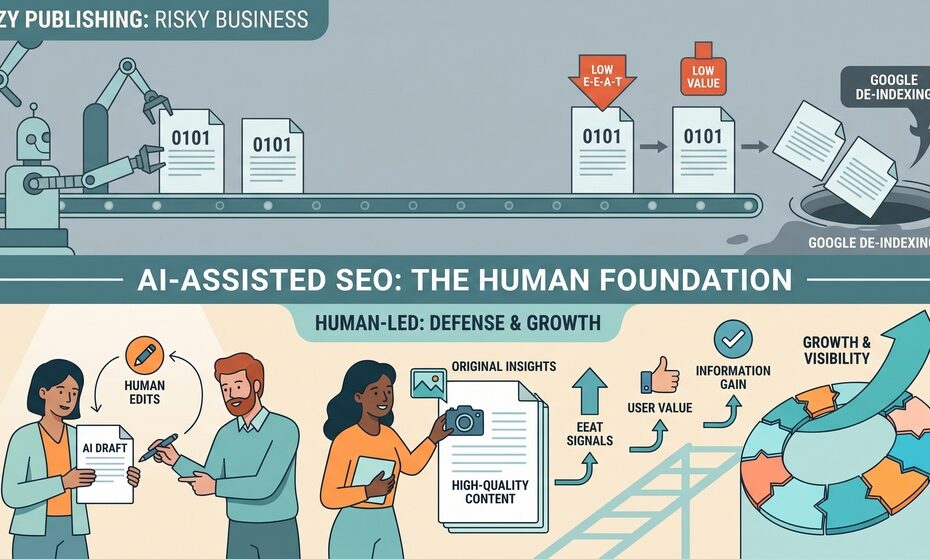
AI writing tools won’t hurt your search visibility, but lazy publishing will. Google doesn’t penalize content simply because it was generated by AI. However, there is a key difference between using AI as an assistant and using it to replace your entire team. Publishing raw, unedited AI content without human expertise or original insight is risky. It triggers Google’s spam filters, strips away vital E-E-A-T signals and creates the generic “sea of sameness” that modern search engines are designed to bury.
Below, we break down why an AI-only strategy fails, what the data reveals, and how to leverage AI without sacrificing your organic rankings.
Google’s Actual Position on AI Content
Google doesn’t ban AI content. According to official Google Search Central guidance, using AI or automation is entirely acceptable as long as the output is high quality. The issue lies in intent. Google explicitly warns that using AI primarily to manipulate search rankings violates its spam policies.
This is where fully automated content strategies fail. If an entire site is machine-generated without added human value, passing Google’s “primary purpose” test is nearly impossible. Mass-producing low-effort pages crosses directly into scaled content abuse, triggering strict spam penalties.
Scaled Content Abuse: The Policy Built for AI-Only Sites
In March 2024, Google replaced its old “automatically generated content” policy with a broader standard: scaled content abuse.
This policy targets websites that mass-produce pages primarily to influence search rankings rather than help users. While the rule is method-neutral (penalizing thin human writing just as harshly) generative AI is what made mass production effortless. This makes AI-heavy sites the primary target for enforcement.
Google initially rolled out the policy alongside its March 2024 core update, intending to cut low-quality, unoriginal content by 40%. Enforcement has only intensified since, remaining a central focus through the March 2026 core update. Remarkably, Google has clarified that these spam penalties don’t just affect traditional blue links. They directly impact visibility across AI Overviews and AI Mode as well.
So, to clarify:
-
The Shift to “Scaled Content Abuse”
In March 2024, Google updated its spam policies to target any mass-produced content created solely to game rankings without offering user value.
-
Why AI is in the Crosshairs
The policy penalizes low-quality content regardless of how it is made, but generative AI’s ability to create volume at scale makes it the main enforcement target.
-
Aggressive Enforcement
Originally aimed at slashing unoriginal search results by 40%, this policy remains heavily enforced through the March 2026 core update.
-
Total Search Impact
Scaled content abuse penalties now govern visibility across the entire search ecosystem, including AI Overviews and AI Mode, not just classic search listings.
What Happened to Sites That Went All-In on AI
Quality Raters Now Flag Unedited AI Content as “Lowest” Quality
The March 2024 core update offered undeniable proof of this shift. Google issued manual actions that completely deindexed hundreds of websites overnight, and wiping out their organic traffic entirely.
An Originality.ai study revealed that 100% of the penalized sites showed signs of AI-generated content, with half relying on AI for 90% to 100% of their posts. Later industry analyses showed over 1,400 sites received manual actions, all sharing a distinct profile: high AI detection scores, aggressive publishing rates, generic structures, and no original research.
The takeaway from programmatic SEO case studies is clear: AI-assisted writing is fine, but publishing raw, AI-only content at scale has become an algorithmic kill switch.
The E-E-A-T Problem: AI Has No Experience
Google’s ranking systems reward content demonstrating E-E-A-T (Experience, Expertise, Authoritativeness, and Trustworthiness. The first E, Experience, was added specifically to reward first-hand knowledge: actual use of the product, performing the service, or visiting the location.
Where does exclusive AI content structurally fail? It is here:
-
No first-hand experience.
An AI Agent has never installed a water heater, audited a Google Business Profile, or tested a POS system. It can only remix descriptions of real human experience.
-
No verifiable expertise or accountability.
AI-only sites typically lack named authors with real credentials — a signal raters and algorithms look for, especially on YMYL (health, finance, legal) topics.
-
Factual reliability risk.
Models hallucinate statistics, misstate regulations, and produce outdated claims. Publishing unreviewed AI output means publishing errors under your brand, eroding trust signals over time.
Analysis of the March 2026 core update revealed that Google recalibrated its quality signals around “information originality”, prioritizing whether a page adds new insights found nowhere else. Under this framework, AI-assisted content thrives when it is substantially edited, grounded in original viewpoints, and attributed to a verified human expert. In contrast, generic, fully automated AI output continues to lose visibility.
What Works: AI-assisted content that is thoroughly refined, brings a unique perspective, and carries the byline of a recognized human expert.
What Fails: Unedited, mass-produced AI output that merely summarizes existing web pages.
Zero Information Gain: You Can’t Outrank Your Own Training Data
Beyond policy enforcement, there is a fundamental flaw with automated content: AI models generate text by predicting likely patterns from what already exists. By design, pure AI output is just a statistical average of current search results. It cannot produce original test results, fresh data, unique opinions, or firsthand reporting.
This directly clashes with Google’s focus on “information gain”. That is the net-new value a page provides beyond existing sources. An AI-written guide on “the best new tools for contractors” will say the exact same thing as dozens of identical articles published that same week. That gives search engines no reason to rank your page, and zero incentive for AI Overviews to cite you as a source.
Furthermore, 100% AI-generated text carries obvious fingerprints. They include repetitive headers, predictable hedging, and rigid listicle formats. As millions of websites churn out content using the same foundational models, that widespread sameness becomes its own red flag for low quality.
The User Signals Catch Up Even If the Algorithm Doesn’t
Suppose an AI-only page slips through and ranks. Users still have to engage with it. Generic AI content typically:
- Opens with filler (“In today’s fast-paced digital landscape…”) before answering the question, driving visitors pogo-sticking back to the search results.
- Fails to match true search intent. This could mean answering “how to fix a leaky faucet” with paragraphs of plumbing history
- Contains nothing quotable, linkable, or shareable. The page earns no backlinks, mentions, or brand searches. They are the signals that build the site-level authority rankings depend on
The Helpful Content system, now folded into Google’s core ranking algorithms, evaluates these people-first quality signals sitewide. A site composed mostly of unhelpful pages can see its entire domain demoted. This means a large volume of unedited AI content can drag down even your genuinely good pages.
The Risk Profile: Sitewide, Sudden, and Hard to Reverse
An exclusively-AI strategy concentrates risk in ways traditional content strategies don’t:
-
Sitewide classifiers, not page-level ones.
Scaled content abuse and helpful-content signals evaluate patterns across your whole site. When they trigger, everything drops, not just the worst pages. How is your website doing? If legitimate pages are filed “discovered, not indexed” there are problems with content that must be addressed.
-
Manual actions can mean total deindexing.
As the March 2024 wave showed, Google’s web spam team can remove a site from the index entirely, and recovery requires cleanup plus a reconsideration request with no guaranteed timeline.
-
Recovery is slow.
Sites hit by core-update quality demotions typically must demonstrate sustained improvement across future core updates, often months to a year, before regaining visibility.
-
The traffic was rented, not owned.
Sites built on mass AI content have no brand, no audience, no email list, and no defensible position when the algorithm shifts.
For an agency or a small business, that’s an existential risk taken to save a copywriting budget.
How to Use AI Without Hurting SEO
The solution isn’t to abandon AI. It’s to stop using it as an end-to-end replacement for human work. A sustainable, algorithm-proof workflow comes down to five core practices:
-
Assist, Don’t Automate:
Offload research, outlining, and administrative tasks (like schema or meta tags) to AI, but keep editorial control in human hands.
-
Prioritize Information Gain:
Layer in original research, unique photos, proprietary data, and distinct opinions that machine models cannot synthesize.
-
Ensure Named Accountability:
Back your content with verified subject-matter experts who actively edit and fact-check the material.
-
Focus on Depth Over Scale:
Prioritize a handful of definitive, best-in-class resources over high-volume, automated publishing sprees.
-
Clean Up Existing Thin Content:
Systematically audit your library to upgrade or delete low-effort AI pages before search algorithms flag them.
The Bottom Line
Google’s systems don’t care whether a human or a machine typed the words. They care whether the page is helpful, original, accurate, and made for people. Content that is exclusively AI-generated almost never clears that bar. It adds no experience, no new information, and no accountability. It matches the precise definition of Google’s most actively enforced spam policy. The sites that were deindexed didn’t get caught for using AI; they got caught for publishing nothing but AI. Use the tools, but make sure a human with real expertise is the reason the content deserves to rank.