
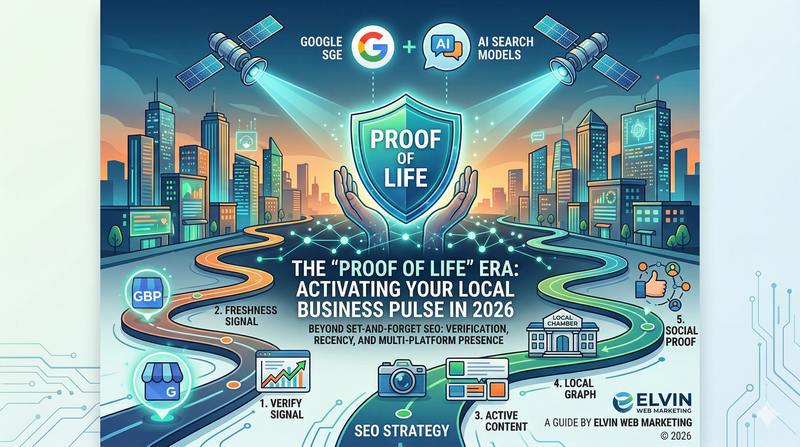
For over a decade, the pitch for local SEO was simple: build a clean website, pepper it with the right keywords (e.g., “Roofing in Milford, CT”), and wait for the phone to ring. This was the era of “Set It and Forget It” marketing—a world where a digital presence was merely a static billboard on a high-traffic highway.
That era officially ended in early 2026.
As we navigate this spring’s unique economic climate, U.S. GDP growth is projected to reach 2.4%. However, consumer sentiment is being battered by spiking oil prices and sticky inflation. In this environment, local businesses can no longer afford to be digital ghosts. Today, Google’s AI-driven search experiences don’t just “read” your website; they verify your existence.
If your business doesn’t have a “Digital Pulse,” you aren’t just falling in rank; you’re becoming invisible to the very AI models that now curate over 80% of local search intent.
In 2026, we are firmly in what I call the “Proof of Life” Era. It’s a digital landscape where businesses must continuously demonstrate activity, relevance, and credibility across multiple platforms just to remain visible. Today, being online is no longer enough. You have to be actively alive online.
1. The Shift from “Keywords” to “Entities”
In the “old” days, search engines were akin to sophisticated filing cabinets; they searched for matching words. In 2026, search engines are Reasoning Engines. They treat your business as an “Entity”—a living, breathing organization with a reputation, a physical location, and a real-world impact.
When a homeowner searches for “emergency plumber near me,” the AI is cross-referencing:
-
Your Google Business Profile (GBP): Is it merely a listing, or is it a dynamic storefront?
-
Social Proof: Are people mentioning your brand on LinkedIn or local community groups?
-
Real-World Verification: Does your profile show AI-generated service listings based on what the AI “thinks” you do, or have you taken control of that narrative?
The biggest shift driving this change is the collapse of traditional search behavior. For years, SEO revolved around rankings and clicks. But now, users aren’t clicking the way they used to:
-
Zero-Click Reality: Roughly 58–60% of Google searches now end without a click.
-
Instant Answers: AI-generated answers often satisfy the query instantly, eliminating the need to visit a website.
-
Evaluation over Discovery: 80% of consumers rely on zero-click results for a significant portion of their searches.
Your website is no longer the final destination; it’s just one signal among many.
2. The Collapse of Passive Visibility: “Recency Bias”
We are currently seeing a massive “Recency Bias” in how AI-generated answers are formulated. Because information moves so fast in 2026, search models prioritize “Freshness” over “Authority.”
A legacy company with 500 reviews from 2022 is now losing ground to a new contractor with 45 reviews—all from the last three months. Industry data shows that 74% of users prioritize recent reviews over total volume.
The Lesson: You cannot “bank” your reputation. In the 2026 economy, reputation is a subscription service—you have to pay for it with consistent activity every single month.
3. Digital Stagnation = Digital Invisibility
In 2026, inactivity doesn’t just hurt performance; it actively disqualifies you. Here’s how digital stagnation shows up:
-
Outdated Websites: A site that hasn’t been updated in years signals neglect. AI systems prioritize freshness and relevance.
-
Inconsistent Listings: If your business information varies across directories, it reduces trust signals. Consistency is now a core ranking factor.
-
Lack of Reviews: A business with no recent reviews appears inactive. AI heavily weighs recency and sentiment when making recommendations.
-
No Social Activity: You don’t need to go viral, but complete silence sends a message of stagnation.
At Elvin Web Marketing, we’ve seen a dramatic shift: businesses with “perfect” SEO but zero recent activity are being outranked by smaller competitors who are consistently active.
4. The Economic Context: Why “Trust” is the New Currency
The 2026 economy is in a “tug-of-war.” While productivity is high, the average household is feeling a massive pinch. As of April 2026, gas prices have spiked significantly due to geopolitical tensions, leading to a pull-back in discretionary spending.
When money is tight, consumers become risk-averse. They aren’t just looking for the first professional they find; they are looking for the one that appears to be the safest bet. If a potential client lands on your blog and the last post is from 2024, a subconscious seed of doubt is planted. In a high-interest-rate environment (currently holding at 3.5% to 3.75%), trust is the ultimate conversion tool.
5. The Three Pillars of a “Digital Pulse”
To survive the 2026 landscape, your marketing strategy must move from “maintenance” to “momentum.” Here are the three pillars we focus on:
I. The Content Loop (Beyond the Blog)
Your content needs to show Real-World Activity.
-
Case Studies over “Tips”: Instead of writing “5 Tips for Roof Maintenance,” write “How We Saved a Local Homeowner $10k After the March Storms.”
-
Visual Evidence: Uploading photos directly to your GBP tells the AI: “This entity was active at this location on this date.”
II. Intentional Review Velocity
“Review Velocity” is the speed at which you acquire new feedback. Steady signals build trust, while artificial spikes create suspicion. You need a steady drip of reviews to signal that your business is consistently satisfying customers in real time.
III. Local Connectivity (The “Neighborhood” Factor)
AI search models are increasingly looking at your “Local Graph.” Are you linked to the local Chamber of Commerce? Are you mentioned in local news? In 2026, SEO is as much about Public Relations as it is about technical code.
6. How to Audit Your “Pulse” Right Now
Ask yourself these four questions:
-
The 30-Day Rule: Have I posted a new photo, update, or blog post in the last 30 days?
-
The Review Gap: Is my most recent Google review more than three weeks old?
-
The “AI Verification” Test: Does Google’s AI automatically list your services accurately, or are you being misrepresented?
-
The Mobile Reality: Does my Google Maps pin show my current hours and recent customer photos?
7. Marketing as an Asset, Not an Expense
Many business owners see marketing as a “bill” they pay every month. But in 2026, marketing is more like fuel. If you stop pumping it, the engine stalls.
At Elvin Web Marketing, we don’t just “do SEO.” We manage your Digital Momentum. We ensure that when the AI bots crawl the web looking for a reliable professional to recommend, they find a “Verified Local” entity that is active, trusted, and engaged.
The economy might be in a “tug-of-war,” but your visibility shouldn’t be. In a world where AI is the gatekeeper, your activity is your authority.
The “proof of life” framing is a sharp way to put it. This matches what I see running campaigns for local businesses: the ones with a “perfect” static site but no recent activity quietly slip, while smaller competitors who post, gather fresh reviews, and keep their profile active pull ahead. Your recency point especially rings true. A steady drip of recent reviews now seems to reassure both customers and the AI far more than a big pile of old ones. The 30-day audit question is a genuinely useful gut check too. Treating marketing as momentum rather than a one-time setup is the shift a lot of owners still have not made. Thanks for a timely read.