
“AI Readability” Metrics are the New Core Web Vitals
For the last few years, local business owners and digital marketers have lived by a strict technical playbook: Core Web Vitals. We optimized for Largest Contentful Paint (LCP), Interaction to Next Paint (INP), and Cumulative Layout Shift (CLS) to ensure pages loaded fast and stayed stable. If your site passed the test, Google’s mobile crawlers rewarded you with strong organic positioning.
But the baseline has fundamentally shifted to AI Readability
We have officially entered the age of the Zero-Click Search. Between Google’s Gemini-powered AI Overviews, OpenAI’s SearchGPT features, and platforms like Perplexity, consumers are getting complete answers, including local brand recommendations, directly inside conversational interfaces.
Because generative search increasingly quotes, summarizes, or synthesizes page content, simply “being indexed” by Google is no longer enough. You need your content to be both technically reachable and linguistically legible to models building real-time answers. AND IT MUST BE ORIGINAL!
To survive, you need to look beyond traditional page-speed metrics and master a separate optimization layer: AI Readability.
What is “AI Readability” anyway?
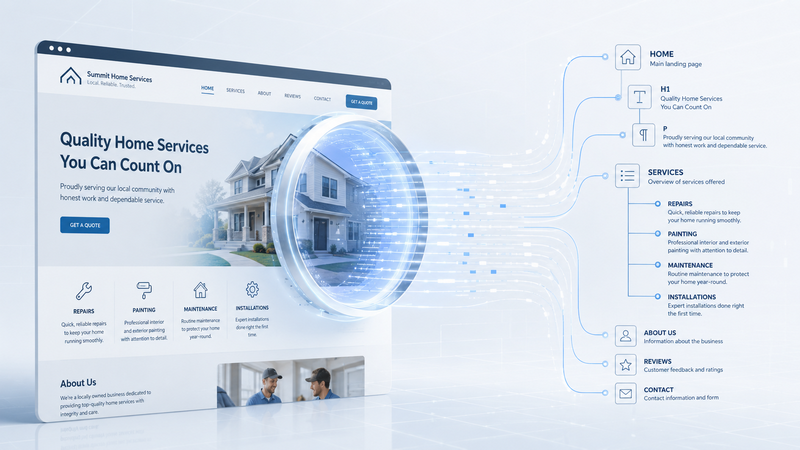
AI readability measures how easily a page’s raw HTML, structure, and language can be ingested, understood, and safely reused by large language models (LLMs) like ChatGPT, Gemini, etc.
Strong Core Web Vitals support better human engagement, but they do not guarantee that your content is structured properly for AI. AI readability bridges that gap.
Core Web Vitals vs. AI Readability
To understand how the technical landscape has split, it helps to look at how human-facing metrics compare directly to machine-facing metrics:
| Optimization Aspect | Core Web Vitals Focus | AI Readability Focus |
| Primary Purpose | Human UX and ranking boost in classic search | Machine comprehension and AI answer inclusion |
| Metric Layer | LCP, INP, CLS performance thresholds | HTML visibility, structure, language clarity |
| Data Source | Chrome UX field data (CrUX, PageSpeed Insights) | Crawler-facing HTML, AI citation patterns |
| Rendering Assumption | Fully rendered browser experience | Limited or no JavaScript rendering |
| Optimization Outcome | Faster loads, fewer layout shifts | Better inclusion/accuracy in AI summaries |
The 6 New AI Readability Metrics You Must Track
To verify that your site is machine-readable, look at these six modern indicators:
1. Raw HTML Exposure Ratio
Many modern WordPress themes and heavy page-builders hide core body text behind JavaScript. The catch? Many AI crawlers do not execute JavaScript or place strict limits on rendering. If your text only triggers after JavaScript runs, it effectively vanishes from an AI’s view.
-
What to track: The percentage of primary copy visible in the raw HTML response before JavaScript executes.
2. Semantic Structure Depth and Clarity
Models rely heavily on clean semantic hierarchies to understand data context and relationship depth.
-
What to track: Structuring your page templates with a clear, predictable outline (using tags like H1,H2, and H3) and embedding background code blueprints like local business, service, and FAQ schema.
3. Answerability and Snippet Density
Generative systems look for self-contained, high-precision text segments that directly answer specific user questions.
-
What to track: The number of explicit Q&A pairs on a page, and the proportion of content written in short, standalone paragraphs or definition-style sentences (e.g., “X is…” or “To do X, you…”).
4. Entity and Intent Coverage
LLMs organize knowledge around defined entities (brands, services, locations) and clear user intents.
-
What to track: The consistent presence of your business name, primary service, and target city above the fold, alongside internal links that clarify user intent (e.g., pricing links or comparative guides).
5. Thin or Low-Quality Segment Share
While traditional SEO worries about thin pages, AI readability focuses on thin segments inside a page. AI quality systems quickly flag boilerplate, repetitive, or template-driven paragraphs as low-value noise.
-
What to track: The ratio of unique, highly specific expert content compared to repeated boilerplate paragraphs across your service and city location pages.
6. AI Citation Velocity
This is the ultimate strategic metric: how often your business domain actually appears as a sourced link or mention in AI responses over time.
-
What to track: The baseline frequency of your brand or domain mentions in generative snippets, and how those mentions spike after content updates.
How to Audit Your Site for AI Readability
You don’t need to check every page manually. Select a handful of representative templates—your homepage, a major service page, a location page, and a couple of blog posts—and run them through this framework:
-
Simulate Non-Rendering Crawlers: Load your pages with JavaScript disabled. Note if your main value propositions, pricing tables, hero text, or call-to-actions disappear. If they disappear, AI crawlers likely can’t read them either.
-
Map Content Blocks: Extract your headings. Do they form a highly logical, predictable outline that addresses standard customer search intents?
-
Evaluate Answerability: Highlight text blocks that directly answer a consumer’s query. Count your explicit Q&A pairs. Identify gaps where you have substituted fluff for a direct answer.
-
Verify Entity Connections: Confirm that your schema markup uses connected JSON-LD nodes. Make sure it uses the sameAs attribute to link your website directly to your official Google Business Profile, state licenses, and trusted social footprints to remove ambiguity.
-
Quantify Boilerplate Noise: Compare your location or service page variants side-by-side. If 80% of the text is identical filler with only the town names swapped, the template signal-to-noise ratio is too low.
The Optimization Playbook: Making Your Site AI-Readable
If your audit reveals gaps, implement these three structural updates immediately to align with modern extraction patterns:
1. Prioritize Server-Side Visibility
Ensure your most critical business copy, location details, and core answers ship immediately in the initial, raw HTML response. Minimize dependency on client-side rendering widgets or heavy client-dependent JavaScript plugins for your primary text blocks. What a text-only browser displays should closely mirror your primary content.
2. Tighten Structure & Chunk Content for Reuse
Structure your layouts so sections can stand perfectly on their own if isolated or quoted by an AI engine. Use highly descriptive H2 and H3 headers, short paragraphs, bulleted step-by-step guides, and clear Q&A blocks. For instance, build distinct blocks explicitly labeled: “What This Service Includes,” “Who This Service Is For,” and “Common Pricing Questions.”
3. Upgrade Content Specificity
Ditch the generic marketing adjectives. Replace boilerplate filler with concrete, hyper-local details that only a field specialist would know. Detail specific regional building regulations, exact job scopes, unique local climate challenges, and real-world project examples. This depth signals to AI models that your page contains unique, authoritative data worth citing.
The Bottom Line
Passing Core Web Vitals proves your website functions cleanly for human users. Optimizing your AI Readability metrics ensures your business is understandable, crawlable, and ready to be recommended by the machines generating the answers. To dominate local search today, you must execute both.
Want to know if your website is built to capture unseen clicks in the conversational search era? Contact the team at Elvin Web Marketing to schedule a comprehensive Local Search and Answer Engine Optimization audit.